genesis | chapter 2
Genesis 2:10 is one of the most architecturally precise verses in the entire passage: (וְנָהָר יֹצֵא מֵעֵדֶן לְהַשְׁקוֹת אֶת הַגָּן), “and a river goes out from Eden to water the garden.”
The verb is a Qal participle yotse ( יֹצֵא, going out), ongoing, continuous, present-tense action. The river is always going out. It is not a past-tense event. This is not an isolated grammatical choice. Genesis 1:24 uses the same root in its Hiphil form, totse (תּוֹצֵא), when the earth “brings forth” every living creature, an emergence of what has been forming within, the same root naming the river’s own outward flow from its source. The Zohar (1:85a) makes a more direct connection: discussing the River Kevar of Ezekiel’s vision, it calls Kevar “River of already, already existing since the day the world was created, upon which Shekhinah reveals Herself constantly,” grounding that claim by quoting this very verse, “A river issues from Eden to water the garden, and from there it divides” (Genesis 2:10–11). The identification is explicit, not metaphorical: Kevar is identified with the Euphrates itself, Perat, one of the four riverheads issuing from Eden (Genesis 2:14; Bereshit Rabbah 16:3), though the midrash itself records this as disputed, with another view holding Kevar and Perat to be two separate rivers. The Zohar is following one side of an older disagreement, not reporting a settled fact. Shekhinah, from shakhan (שָׁכַן), to dwell, is the rabbinic and kabbalistic term for God's indwelling presence in the world, the immanent, felt nearness of the divine rather than its transcendent remove. The Bahir (§5) gives the same image in parable form: “He hewed cliffs and quarried stone, and a great spring of living water came forth for him. The king said, ‘Since I have flowing water, I will plant a garden and delight in it, I and all the world’” (קצץ צורים וחצב סלעים ויצא לו מעין מים גדול מים חיים, אמר המלך הואיל ויש לי מים נובעים אטע גן ואשתעשע בו אני וכל העולם, trans. from the Hebrew, Torat Emet ed.) This is the verb the whole reading of the river sustaining the garden has been resting on. Le-hashkot (לְהַשְׁקוֹת), the verse’s own word for ‘to water’ in the phrase above, comes from shaqah (שָׁקָה), Gesenius: to quaff, causatively to irrigate or furnish drink, is a continuous causative act of supply, not a single delivery.
At the letter level, venahar (וְנָהָר, river) carries four letters in its verse form: Vav, Nun, Heh, and Resh. Vav is hook. Nun is fish. Heh is man calling, jubilant, the stronger of the two available readings for this letter. Resh is head. Read together: a hook joins this current to the garden it is already bound for, the very thing the verse’s own grammar already names: a river goes out from Eden to water the garden. There is a fish in it, submerged wholly within its own water, inseparable from the very medium it moves through, the same reading already given to Eden's own Nun. A voice is already calling inside that current, jubilant. And a head marks the source, the point this current begins from, the same sense English still keeps in the word headwaters. So this is what nahar's letters are already describing: a submerged life, calling, moving out from its own source. The lens reads this a step further: the fish and the voice both describe the same quality from two different aspects. What lives submerged in the water (consciousness), inseparable from the very medium it moves through, is a symbol pointing to the voice itself, an ever-present voice of God the current carries.
At the foundation level, the Warsaw (W) ordering holds: Vav governs Hearing, Nun governs Motion, Heh governs Sight, and Resh governs Seed. Read together: hearing carries this current forward from what came before it, received before it is ever seen, the voice of God heard before it is ever acted on. Motion follows, the same ongoing sense the participle yotse already carries grammatically, a river always going out rather than one that went out once: what is heard stirs movement, a desire rising up in response. Sight comes next: that movement becomes a vision, seen in the mind's eye. And seed comes last, this flow feeding the garden’s own potential for growth rather than settling still: once the vision is seen, the seed is already planted in consciousness. So this is the same claim as the letter level, confirmed a second, independent way: something heard, stirring movement, becoming vision, and planting growth in everything it flows into.
The Name Layer and the Foundation Layer are two sides of the same coin: complementary, not competing, each pointing to a different aspect of the same thing. The Name Layer describes what is present, the letters' own pictures; the Foundation Layer describes how those elements govern, the sequence their function traces as it becomes manifest.
The source of the river is Eden, the state of delight, the pleasant and primordially satisfying inner ground. The river flows from that state outward, into the garden, to water it. The direction of flow is from the inside out: from the deepest inner source (Eden) into the enclosed tended space (the garden). This is the direction of manifestation as the lens reads it: from the state of inner delight outward into the cultivated, tended garden of experience. The verb yotse is not a one-time event; it is a continuous participle, a river that is always going out. The lens reads this direction of flow one step further: if the garden is the prepared, protected condition YHWH-Elohim has taken on, and the river’s going-out is what waters and sustains that garden without ever stopping, then the water itself is that being's own consciousness, continuously flowing outward. There is no separate perceiver here yet, only the same being, wearing the body it shaped from the adamah. The outer world does not feed the inner state from outside. It depends on the inner state entirely: the outer world exists because the consciousness within is flowing outward, and would cease the moment that flowing stopped. It is the inner state, endlessly flowing outward, that keeps the outer world watered and standing, and it will not be until Genesis 3 that anyone is there to call this act perception at all.
Then: 'and from there it was divided and became four heads,' וּמִשָּׁם יִפָּרֵד וְהָיָה לְאַרְבָּעָה רָאשִׁים. One river. From one source. Flowing through one garden. And then dividing into four source-streams, each with its own named territory. Yippared (יִפָּרֶד), was divided, from parad (Gesenius: to break through, to spread, or to separate), names this dividing precisely.
At the letter level, parad's (divides) own written form, yippared, begins with Yod, hand. Parad (divides) itself is Peh, Resh, and Dalet: a mouth, a head, and a door. Read together: a hand is the agent performing the very division about to be named, reaching in and doing the dividing before the word for it is even spoken. That division happens at a mouth: the very point where a river itself divides and fans out is still called its mouth, its delta, letter and landscape both naming the same place. Resh's own name is head, the very word the verse itself uses next, rashim (רָאשִׁים), and that word choice matters: a head is not a leftover fragment of the one river, it's a beginning in its own right, a source rather than a remainder. That's already what the letters are naming here, well before the verse spells out what each of these four sources will become. And Dalet is a door, each of the four heads its own threshold opening into its own distinct faculty of awareness, four separate openings into experience rather than four fragments of one broken thing. The letters and the verse's own vocabulary meet at two separate points, not one: mouth and head both, the division already legible in the word before the verse ever spells it out. Psychologically, this is the same point: this is exactly where the one voice, already heard at the source, begins to travel outward through the four faculties, not breaking into a lesser fragment but expressing itself through the separate paths it opens into.
At the foundation level, the Warsaw (W) ordering holds across all four letters, the grammatical Yod included: Yod governs coition, Peh governs grace, Resh governs seed, and Dalet governs wisdom. Read together: coition's own generative force is what's being read here, not its unifying motion: the same creative charge that makes one become two is what multiplies the one river into four, read here at the very letter whose name-layer picture, a hand, is already the agent of that becoming. Grace is what that same mouth looks like from the other side: a river's own delta doesn't tear apart, it fans out naturally, the same freely given multiplying this division is read as rather than a diminishment. Seed repeats the same reading already given to nahar's own Resh: each of the four carries forward the same seed-quality of ongoing growth, now sent outward into four distinct territories rather than one. Wisdom governs here: the same discernment Dalet’s own door already pictures at the name layer, what each of the four faculties will come to open itself to once it is out in the external world. A generative division, freely given, seeding growth in every direction, at a threshold of wisdom.
Parad (divides) names the dividing. The verse's next word names what followed it: vehayah (becomes), and it became.
At the letter level, vehayah (becomes), "and it became," carries its own letters, four of them: Vav, Heh, Yod, and Heh. Vav is hook. Heh is man calling, jubilate. Yod is hand. Read together: a hook forges the literal joint between dividing and becoming, naming them in one continuous breath rather than one completed event followed by another, and reaching back further still to the voice that started it all in nahar's own Heh, the hook is what carries that first call forward into what happens next. But the letters don't just join two events, they bracket them. The root’s own first and last letters repeat the same reading already given to nahar's Heh, man calling or jubilate, a joyful call, present the whole time the river flows as one, and here that same call opens the word and closes it, standing on both sides of the becoming itself. And a hand is the agent of that becoming, the same reading parad’s (divides) own Yod already carries at the moment it names the dividing, now internally carrying forward what was first only heard, the voice itself present in the hand’s own work rather than left behind the moment it was spoken.
At the foundation level, the Warsaw (W) ordering holds: Vav governs Hearing, Heh governs Sight, Yod governs Coition, and Heh governs Sight again. Read together: hearing is hearing God, received first, internal, its own thing entirely, untouched by whatever the river is about to become. The first Sight is what was heard becoming a vision, seen internally, still private, not yet in the world. Coition is the generative force that will come to make itself manifest, the same force that will carry that internal vision out into the world rather than leaving it a private seeing, the same generative force already read into parad’s (divides) own Yod. And the second Sight is creation becoming visible in the external world: what was first heard will come to show up through four distinct faculties, and what those four faculties will come to produce will then be made manifest in the world for all to see.
At the letter level, arba'ah, "four," carries its own letters, six of them: Lamed, Aleph, Resh, Bet, Ayin, and Heh. Lamed is ox-goad. Aleph is ox. Resh is head. Bet is house. Ayin is eye. Heh is man calling, jubilate. Read together: a goad pushes an ox forward, directed power, not wild, the same raw-power-directed reading this piece already gave Aleph in Elohim's own paragraph. That directed power reaches four heads now, not one, its own dwelling, its own governed territory. Inside each of those four houses, an eye opens, each of the four faculties will be used to perceive the external world for itself, the same eye standing for perceiving as such, not the literal sense of sight alone but the root each of these four heads will draw its own faculty from. And a voice, already calling, already joyful, is heard there too, now reaching its fullest, most articulated form of expression. That's the word arba'ah's own shape too: its root carries the sense of being spread flat at all fours, not shrunk into four smaller pieces but stretched fully into its complete extension.
At the foundation level, the Warsaw (W) ordering holds: Lamed governs Action, Aleph is the fixed Mother letter, Air, Resh governs Seed, Bet governs Life, Ayin governs Laughter, and Heh governs Sight. Read together: Action is present in this dividing, driving force threaded all the way through. Air holds the center, fixed, one of the three Mother letters, the ruach movement moves through before anything is carried out. Seed is the potential for growth already carried in that same field, the same seed-quality parad’s own Resh already sent outward into four distinct territories. Life is what that potential actually is, not a bare structural fact but a living thing. Laughter is the joy already inside that life, not separate from it. And Sight is this whole field named at last: action, air, seed, life, and joy, all of it something that will come to be seen.
The lens reads the four-fold division as the movement of the single creative power into the four dimensions of its expression. One becomes four not by dilution but by full articulation: the single creative stream fully expressing itself in all directions.
The Four Rivers of Perception: Pishon as Sight, Gichon as Taste, Chiddekel as Touch, and Perat as Smell
Before turning to each river by name, one more pattern is worth naming: the single, undivided river is already the source's own voice, established at the letter level: nahar's Heh, man calling or jubilate, a voice already speaking before it ever divides. That voice is not left behind when the river divides. It fully and equally articulates into all four heads, one voice now expressed as four distinct functions. This isn’t literal, as if hearing persisted as its own separate organ working beneath the other four; the voice travels through sight, taste, touch, and smell themselves, metaphorically, as the very function each one carries out. In psychological terms, hearing represents inner knowing, the intuitive impression from the I AM within us, now present as the animating essence inside sight, taste, touch, and smell alike, the very channels through which that inner voice is carried outward and expressed. Each of the four senses is driven into action by that one voice; their function is led by it, not substituted for it. These are the four ways that same awareness turns outward when the source becomes four.
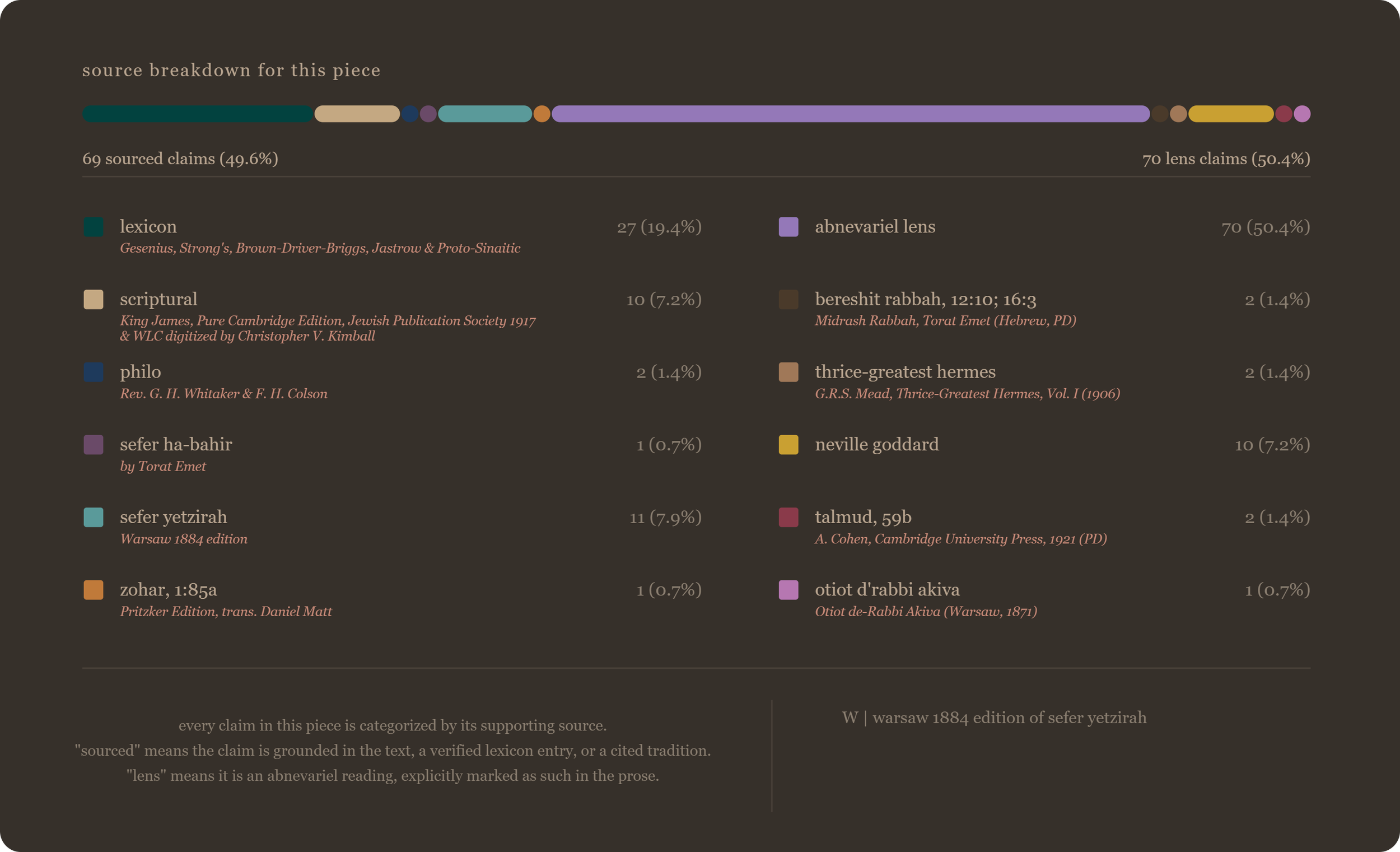
A note on sourcing for this fourfold sense reading: the closest ancient precedent found for treating these rivers as bodily faculties at all is a second-century Gnostic document preserved by Hippolytus of Rome and quoted in G.R.S. Mead's Thrice-Greatest Hermes. That source reads Pishon as the eye, sight, matching this piece, though neither reading anchors sight in Pishon’s own letters, and reads Gichon as hearing, Chiddekel as smell, and Perat as the mouth, taste and speech together. This piece reads Pishon as sight not from its own root, which carries no visual sense on its own, but from its territory's own treasure, gold, a seen thing before it is anything else, a shimmer that calls out and pulls the eye toward it the way a voice pulls the ear. This piece reads Gichon as taste rather than touch because its own root, to burst forth, lands more literally on taste's explosive, in-the-mouth character, the way a grape bursts open against the tongue, than on touch's steadier, testing quality. This piece reads Chiddekel as touch, rather than smell, for the same reason in reverse: its own letters, fence and door, are boundary and contact images, and touch is the sense that tests an edge directly at the point of contact, the hand's own discrimination before something is accepted or taken in further. This piece reads Perat as smell, rather than taste, because a Talmudic wordplay on its name, not its own lexical root, points to fruitfulness (Berakhot 59b: "its waters are fruitful and multiply"), a ripeness announced on the air before it is ever touched, tasted, or seen, and because it alone, of the four, is given no verb and no bounded territory in the text, matching smell's own total lack of containment, a scent that disperses rather than stays put. Hearing is not kept out of the four rivers; it is already present in the source itself, nahar, the single river carrying God’s own indwelling presence, before any dividing happens, and it persists equally inside each of the four once they divide. Hippolytus assigns hearing to a single head among four, Gichon rather than setting it apart; this piece claims that the four senses, sight, taste, touch, and smell, are each brought into subjection to that one voice already heard at the source, the outward-facing instruments the single, internal hearing uses to meet the external, material world once the stream has already gone out.
That's the sense-pattern the rivers carry. There's a second pattern in how the verse names each one, worth seeing before meeting the rivers themselves.
Each river is introduced by shem (שֵׁם), name, and each encircles, savav (סָבַב), encircling, a specific territory. Each river has a name that declares its essential character, and each encompasses (goes around, surrounds) a whole land. Ha-echad, the first, still carries the root echad (אֶחָד), Strong’s: united, one, a faint echo, not load-bearing on its own, but a reminder that the four rivers about to be named begin from a single, united source.
At the letter level, savav is the same verb both Pishon's and Gichon's verses use for encircling, just spelled two different ways depending on which verse it's in: ha-sovev (הַסֹּבֵב) at Pishon (2:11), four letters, and ha-sovev (הַסּוֹבֵב) at Gichon (2:13), five, the extra Vav a plene spelling of the same word.
At the letter and foundation level together, Pishon’s savav carries three root letters: Heh, the definite article, man calling or jubilate at name level, Sight at foundation level; Samekh is prop or support at name level, Anger at foundation level; and Bet is house at name level, Life at foundation level, written out twice, the geminate spelling. Samekh is the only new reading here, the rest already established elsewhere in the piece. Read together: Sight opens the territory first as something seen, fitting for Pishon especially, the first of the four outward senses named as sight itself, while a voice already calls within that same field of awareness. Samekh’s steadying support holds it firm beneath that call, and its foundation value, Anger, turns the seen territory into a guarded one, held not just by outline but by a defensive, protective force. And Bet closes the root, doubled rather than marked with a single dagesh, its house reading directly onto what savav itself means, an enclosure, the very shape of a territory being surrounded, while its foundation value, Life, makes this a living claim rather than a bare fact.
Gichon’s savav tracks the same three letters, Heh, Samekh, and Bet, but its fuller, plene spelling adds a fourth: Vav is hook at name level, Hearing at foundation level, present only here. Read together: the hook is the connecting loop that is the encircling motion itself, curving back to where it started, and it carries that same current forward, something already received, heard before it is ever seen.
Pishon: Genesis 2:11–12 | שֵׁם הָֽאֶחָד פִּישׁוֹן הוּא הַסֹּבֵב אֵת כָּל אֶרֶץ הַֽחֲוִילָה אֲשֶׁר שָׁם הַזָּהָֽב וּֽזֲהַב הָאָרֶץ הַהִוא טוֹב שָׁם הַבְּדֹלַח וְאֶבֶן הַשֹּֽׁהַם | the name of the first is Pishon, it is the one that circles the whole land of Havilah, where there is gold, and the gold of that land is good; bdellium is there, and the onyx stone.
Pishon: circles Havilah, where there is gold, and the gold of that land is good. Pishon is the first of the four outward senses: sight. Sight is the sense that takes in a territory's full extent at a glance, and Pishon's own territory is announced by exactly that, a visible treasure named for its being seen. The text goes out of its way to say the gold is tov (טוֹב), good, the same evaluative word used throughout Genesis 1 for the creative verdict. Brown-Driver-Briggs Lexicon classifies this under sense 3, ‘good, excellent of its kind.’ The Genesis 1 creation refrain, ‘and God saw that it was good, excellent’ (1:4, 10, 12, 18, 21, 25) and ‘very excellent’ (1:31), falls under this same sense. The gold of Havilah falls under the same sense too, specifically ‘of minerals, fine, pure,’ where BDB’s own citation for this sense is this verse: זהב Gn 2:12. Both the creation refrain and the gold are classified under the same core sense of tov in the standard lexicon.
At the letter level, Pishon's own letters, in full, are five: Peh, Yod, Shin, Vav, and Nun. Peh is mouth. Yod is hand. Shin is tooth. Vav is hook. Nun is fish. Read together: Peh’s mouth opens to declare this river into its own distinct identity, set apart from the undivided current it came from, and the hand creates what the mouth declares. Tooth separates what is true from what is false, holding the one apart from the other. Even as it takes on its own name, a hook keeps this faculty attached to where it came from: the same underlying awareness that makes perception possible through sight as its instrument. And underneath all of it is what's actually alive here: the same voice that was always there, still fully present inside this instrument, the way a fish lives submerged within its own water, carrying the naming, the acting, and the testing all at once.
At the foundation level, the Warsaw (W) ordering holds across four of the five letters: Peh governs Grace and Yod governs Coition. Shin itself is one of the three fixed Mother letters (Sefer Yetzirah 3:4), governing not a simple or double faculty but an element outright, Fire, the same fixed status already given to arba'ah's own Aleph, Air. Vav governs Hearing and Nun governs Motion. Read together: Grace opens the name, this river's own gift rather than an earned thing. Practiced in inner speech, the ongoing conversation that shapes what sight perceives. Coition carries that grace into action, actively carrying it out rather than leaving it passive. Fire consumes what tooth has already tested and found false, transforming this faculty by burning away whatever doesn't survive that test. Vav governs Hearing: what's heard is the voice already there in the river before it divided, this river too still carrying that current beneath it, and hearing informs this faculty's ability to perceive the world. And Motion closes the name, this river still moving even once it is named and given its own territory: the same voice already alive inside this instrument doesn't just speak, it desires, moving in the deep as the fish itself, waiting to be caught.
Neither layer's own letters spell out which sense this river carries, that comes from savav's own letters instead. Tooth and hook alone carry that connective weight, taking that already-established fact and showing how this river’s own faculty, sight, is shaped by what they govern. What both prove is continuity: Pishon's letters keep repeating nahar's, Eden's, and vehayah's own readings, this now-separate, now-named river still carrying the same qualities the single, undivided current already had. That's Pishon's own name. The territory it circles carries its own named treasure too: zahav, gold.
Zahav (הַזָּהָב), gold, per Strong's, comes from an unused root meaning to shimmer, gold defined by its own visual glimmer before anything else, zahav's own letters, Heh, Zayin, Heh, and Bet, mostly repeat readings already carried elsewhere.
At the name level: the first Heh is the definite article, read here the same way as everywhere else in this piece, man calling or jubilate. It turns zahav, gold in general, into this specific gold, the gold that belongs to this land. Zayin is a weapon, a blade that cuts away what no longer serves. Cutting it away is what frees gold from the ground, and what’s freed becomes provision, this land’s own wealth rather than something still held back. The second Heh is man calling, jubilate, the same joyful quality already read into nahar’s own Heh. This world itself was made with a Heh, a wordplay on the word for when heaven and earth were created (Bereshit Rabbah 12:10), fitting since Heh is this same calling voice. Gold does with light what that voice does with sound: its shimmer calls out and pulls the eye toward it before anyone ever says its name. Bet is house, the same reading already given to arba’ah’s own Bet: gold’s own site, the place where it is kept and found, and the same kind of house arba’ah already named as where perception itself is housed. This house is also where understanding lives, and it’s something built, not simply found standing there. Gold’s own house, then, is less a place than a state this land holds.
At the foundation level: the first Heh is Sight, meaning gold is a seen thing, the same anchor already read into nahar’s own Heh, matching its own root’s shimmer directly, a visual glimmer rather than a spoken or handled quality. Heh’s own picture confirms this independently: ‘Heh is symbolized as a window,’ Neville says, ‘the window of the man is his mind. With my mind I see. With my imagination I see.’ Zayin is Smell, carrying no clean anchor of its own. The second Heh is Sight again, doubling the same anchor, gold's own visibility stated twice rather than once. Bet is Life, the same living quality already read into arba'ah's own Bet: Havilah, isn't just a blank fact on a map, it's alive. What zahav actually names is sight’s own first product: value made visible, the mind’s own recognition of what is precious once it actually looks, clarity itself, not yet acted on, only seen and known as good.
That's the gold. The land holds a second treasure too, named in the verse's next clause: bdellium.
Havilah's gold sits next to another treasure, ha-bedolach (הַבְּדֹלַח), bdellium. Its likely root, badal (בָּדַל), Gesenius: to divide, to separate, comes from the same word-family as yippared, the verb that split the one river into four. So this treasure's own name is basically an echo of that splitting event, a little clue lying around that says “something got divided right here.”
At the letter level, bedolach's own letters, in full, are five: Heh, Bet, Dalet, Lamed, and Chet. Heh is the definite article, read here the same way as everywhere else in this piece, man calling or jubilate. Bet is house. Dalet is door. Lamed is ox-goad. Chet is fence. Read together: the definite article marks this as one specific treasure, pointed to directly, not treasure in the abstract. A house is the site itself, the very place this treasure is found. A house holds more than what’s stored in it, understanding lives there too, and it’s built with intention, never simply stumbled upon. This house, like the treasure it holds, is less a location than a state. And the individual letters back up the dividing idea directly: a door is something you pass through to get from one side to another, and a fence is a line that separates one place from another. Both show up here, matching the substance’s own name, badal. An ox-goad closes the word, a farmer’s prodding-stick used to actively push and guide an animal forward. It drives that division forward as an active, ongoing process, fitting because dividing the river wasn’t a one-time snap, it’s read as an ongoing, driven kind of action. What actually drives that action is understanding itself: the heart is where discernment settles, and the heart is also what moves a person to act, the same push an ox-goad gives an animal.
At the foundation level, the Warsaw (W) ordering holds across all five letters: Heh governs Sight, Bet governs Life, Dalet governs Wisdom, Lamed governs Action, and Chet governs Speech. Read together: Sight opens the treasure the same way it already opens Pishon's own name, this substance too first known as something seen, singled out by the very definite article that names it. Heh’s own picture backs this up independently: the same window Neville names elsewhere, ‘the window of the man is his mind. With my mind I see. With my imagination I see.’ Life follows, the same reading already given to savav's own geminate Bet, the same value that makes this a living thing rather than a bare fact, not simply named but alive. Wisdom governs here, the same governing sense already read into parad's own Dalet, discernment in exactly how and where this substance's own name commemorates a dividing, the same door already entered by assumption rather than force. Action carries that discernment forward, the same tool-driven sense already read into shelishi's own Lamed, an ongoing, active work of dividing rather than a single completed one, the same driving force already named as the heart’s own push. And Speech closes the read. ‘In Hebrew it is a Cheth,’ Neville says, ‘and its symbolical value is an enclosure, a protection, a completely protected area,’ calling it ‘the kingdom of God,’ the same protected boundary that decides what actually crosses into speech rather than staying unformed.
That's bdellium. The land holds a third treasure too, named in the same verse: the shoham stone.
Shoham (הַשֹּׁהַם), per Gesenius, comes from an unused root probably meaning to blanch, to turn pale. Gesenius also records two further explanations for the stone's own name: that it resembles a human fingernail in color, and J.D. Michaëlis's proposal that it means striped, comparing an Arabic word for a striped garment. The stone's exact identity is itself uncertain, "probably the beryl" per Strong's, though onyx is the conventional rendering this piece's own closing summary already uses. Shoham's own letters, Heh, Shin, Heh, and Mem, mostly repeat readings established elsewhere.
At the name level: the first Heh is the definite article, read here the same way as everywhere else in this piece, man calling or jubilate, marking this stone as the specific one the verse names. Shin is tooth, carrying no clean anchor to onyx itself. ‘A Shin is symbolized as a tooth,’ Neville says. ‘A tooth is that which consumes, that which devours,’ the same Shin, or flame, he says, that lets a man become detached from what he no longer wants to carry. The second Heh is man calling, jubilate, returning at the root's own center - this stone's own pale shimmer, per its root, another kind of visual calling-out. Mem is water, closing the root.
At the foundation level: the Warsaw (W) ordering holds across the two Heh's only, Shin and Mem both excepted as fixed Mother letters. Read together: the first Heh is Sight, the same anchor already read into Pishon’s own Heh, matching its own root’s shimmer directly, this stone’s own paling already a visible thing before anything else. Shin governs Fire outright (Sefer Yetzirah 3:4), one of the three fixed Mother letters. ‘Were there not within me the flames that would consume it, I would be condemned forever to live in a world of all my mistakes,’ Neville says, ‘...there is a Shin, or flame, within the name of the Son, which allows that Son to become detached from it.’ Mem governs Water outright, another of the three fixed Mother letters. The second Heh is Sight again, doubling the same anchor, this stone too defined by paling, a visible color-change, matching its own root's sense directly. Fire and Water sit side by side at the word's own center, two of the three fixed Mother letters occupying the same small word, which happens to match one old theory about the stone's own name, that it means striped, bands of different color sitting side by side (Michaëlis, via Gesenius), not proven, but worth noting.
Gichon: Genesis 2:13 | וְשֵֽׁם הַנָּהָר הַשֵּׁנִי גִּיחוֹן הוּא הַסּוֹבֵב אֵת כָּל אֶרֶץ כּֽוּשׁ | and the name of the second river is Gichon, it is the one that circles the whole land of Cush.
The second river, Gichon (גִּיחוֹן), to burst forth, compasses the whole land of Cush. Its name carries the root gichon, Gesenius: to burst forth. It is the second of the four outward senses: taste. Taste is itself an explosive, in-the-mouth event, not a gradual unfolding but a sudden bursting open, the same quality the river's own name already carries. Where sight takes in a territory's visible extent from a distance, taste is immediate and consuming, the sense that erupts rather than surveys.
At the letter level, Gichon's own letters, in full, are five: Gimel, Yod, Chet, Vav, and Nun. Gimel is camel. Yod is hand. Chet is fence. Vav is hook. Nun is fish. Read together: a camel is a carrier across distance, the same reach this river's own territory already covers, the whole land of Cush compassed by it. A hand brings forward what is carried, the same agent-quality already read into Pishon's and parad's own Yod. ‘The hand was Jod,’ Neville says, ‘that creative spirit which is the Jod, which is simply being aware,’ the same hand that carries now also the one that first takes hold. A fence marks a threshold too, but here it is the mouth's own boundary, the point taste itself decides what may pass further in and what is refused. ‘In Hebrew it is a Cheth,’ Neville says, ‘and its symbolical value is an enclosure, a protection, a completely protected area,’ calling it ‘the kingdom of God,’ the same protective boundary taste itself performs at the mouth’s own threshold. A hook connects this river back to the single source it still belongs to, the same reading Pishon's own Vav already carry. ‘Vau is symbolized as a nail,’ Neville says. ‘A nail binds together, it joins things together,’ the same binding work that ties this river back to where it came from. And a fish closes the name, submerged wholly within its own water, the same reading Eden's own Nun already carry. ‘Nun means fish,’ Neville says, ‘and fish is the element of the deep, the profound ocean,’ the Saviour of the great deep, he calls it, the same submerged depth already read into this letter.
At the foundation level, the Warsaw (W) ordering holds across all five letters: Gimel governs Peace, Yod governs Coition, Chet governs Speech, Vav governs Hearing, and Nun governs Motion. Read together: Peace opens the name, this territory reached peacefully, flowing around it rather than taking it by force. Coition carries that peace into action. Speech follows, declared rather than merely felt, the same reading already given to bedolach’s own Chet. Vav carries Hearing next, this river too carrying that current beneath it, received before it is ever seen. And Motion closes the name, the same reading Pishon's own Nun already carry, still moving even once this river is named and given its own territory.
Chiddekel: Genesis 2:14 | וְשֵׁם הַנָּהָר הַשְּׁלִישִׁי חִדֶּקֶל הוּא הַֽהֹלֵךְ קִדְמַת אַשּׁוּר | and the name of the third river is Chiddekel, it is the one that goes east of Ashur
Chiddekel (חִדֶּקֶל), "rapid" (Strong's H2313, though both Strong's and Gesenius note the name is probably a loanword, not a native Hebrew root the way Gichon or zahav are), the third river, is the third of the four outward senses: touch. The river is identified elsewhere in scripture as the Tigris: Daniel calls it “the great river, which is Hiddekel” (Daniel 10:4). Philo, reading this same river as the virtue of self-mastery, compares the desire self-mastery must govern to a tiger, “the animal least capable of being tamed” (Legum Allegoriae I), the same governing-by-contact role touch plays before anything is taken in further. Touch is a discriminating sense in its own right, the hand that tests a thing's texture, weight, and temperature before it is allowed any closer, accepted, or refused. Chiddekel's own letters, Chet, Dalet, Qof, and Lamed, mostly repeat readings carried elsewhere.
At the letter level, Chiddekel's own letters, in full, are four: Chet, Dalet, Qof, and Lamed. Chet is fence. Dalet is door. Qof is ape or monkey by its plain pictograph, though Kaplan’s own ordering gives it a different picture here, the back of the head. Qof’s own back-of-head picture points at something touch does without anyone noticing: every time something is tested by touch, it leaves a trace, however small, and that trace has to go somewhere. ‘Divine imagining buries itself in man, in a coffin,’ Neville says. ‘The letter qoph is this,’ the same buried trace touch leaves behind, even when nothing is consciously remembered. Lamed is ox-goad. Otiot D’Rabbi Akiva reads Lamed itself this way: not simply lamed (to learn), but lev (heart), mevin (understanding), and da’at (knowledge), the heart named as what the other two actually rest on. That same source goes further, calling the heart equal to the whole body: it has its own eyes, its own ears, its own mouth, its own speech, its own cry, its own walking, every human faculty mirrored inside it. This river’s own gatekeeping, then, isn’t only tested at its outer edge, it’s driven from the very place that drives a person whole, the heart driving the being.
At the foundation level, the Warsaw (W) ordering holds across three of the four letters: Chet is Speech, this river’s threshold not merely felt but spoken, the same reading already given to bedolach’s own Chet. Dalet is Wisdom, discernment at the very point something is tested before crossing, the same governing sense already read into parad’s and bedolach’s own Dalet. Lamed is Action, an active, ongoing work, now governing this river's own gatekeeping rather than merely naming it. Qof's own Warsaw value, Sleep, has no anchor built for it here yet. Read together: a threshold declared aloud, tested with discernment, and actively governed rather than merely named.
That's Chiddekel's own letters. The word just before it in the verse carries its own letters too: shelishi (הַשְּׁלִישִׁי), third.
Genesis 2:14 itself describes Chiddekel as ha-holekh (הַהֹלךְ ), that goes, that walks, toward the east of Asshur, from halakh (הָלַךְ ), Gesenius: to walk, in a great variety of applications. This is the same verb used later for the sound of YHWH-Elohim mithhalekh (מִתְהַלֵּךְ), walking, in the garden at 3:8. Chiddekel's own walking already carries the quality that will describe the being's presence moving through the garden. It is one continuity of motion, not two unrelated images.
That’s the verb. The word right after it in the verse gets its own letters too: qidmat (קִדְמַת), east of, which carries the same root as miqqedem, qedem (קֶדֶם), “the east, of old” (Gesenius), “front, that which is before, aforetime” (Strong’s H6924), both spatial and temporal priority.
That’s qidmat. The verse’s next word names the place itself: Ashur.
Ashur (אַשּׁוּר), success, per Gesenius, probably derives from ashar (אָשַׁר), to be successful, to be right. If that derivation holds, the territory named along the river's reach carries a sense of rightly-functioning success, the same tov quality already carried by Havilah's gold, now extending outward with the water itself. This rightness borders the one river this piece reads as governance itself: Chiddekel, touch, the sense that tests a thing directly at the point of contact before it is accepted or refused, the same river Philo reads as the virtue of self-mastery, governing desire correctly rather than being ruled by it. A territory named for functioning as it ought, sitting just past the river that stands for getting one's own governance right, is not incidental: touch's own discriminating work, accepting or refusing at the boundary, is exactly the kind of rightness Ashur's own name already describes, the inner rightness that borders discernment itself: once touch has correctly tested and accepted or refused what it meets, what lies just past it is functioning exactly as it should, success read here as right inner governance, not external achievement.
Perat: Genesis 2:14 | וְהַנָּהָר הָֽרְבִיעִי הוּא פְרָֽת | and the fourth river is Perat
The fourth river, Perat (פְרָת), the Euphrates, carries a Talmudic wordplay on its name rather than a shared lexical root: Berakhot 59b reads it as "its waters are fruitful and multiply" (parin u-ravin), punning on parah (פָּרָה), to bear fruit, to be fruitful. Perat is the fourth and final of the outward senses: smell. Smell is the sense most tied to fruitfulness itself, a fruit's ripeness announced on the air before it is ever touched, tasted, or seen. Unlike the other three rivers, Perat is given no named territory in this passage, fruitfulness alone, carried by that wordplay, is what identifies it.
At the letter level, Perat's own letters, in full, are three: Peh, Resh, and Tav. Peh is mouth. Resh is head. Tav is an owner's mark, a cross. Read together: a mouth points toward taste or speech more naturally than smell; the smell reading here rests on the wordplay already named above, not on this letter itself. A head marks the source this river still carries, the same governing sense Resh has already anchored throughout this piece, now a fifth instance of the same running pattern. And an owner's mark closes the name: this river isn’t marked by a territory the way the others are, it’s marked instead by the wordplay already named above, fruitfulness itself serving as its own kind of claim. Tav as the seal names this claim’s own self-warranting character: finished, fixed, needing no outside witness to appear, the same claim already read into this river’s own Dominance.
At the foundation level, the Warsaw (W) ordering holds across all three letters: Peh governs Grace, Resh governs Seed, and Tav governs Dominance. Read together: Grace opens the name, this river's own fruitfulness itself a gift rather than an earned territory. Seed follows, the potential for growth now the very thing this river is named for. And Dominance closes the read, governing without a territory behind it, the claim answering to nothing outside itself, this river’s own fruitfulness its only required warrant.
Philo reads these same four rivers as the four cardinal virtues: prudence, self-mastery, courage, and justice, each an efflux of a single generic virtue he calls goodness, itself issuing from Eden, “the Wisdom or Reason of God” (Legum Allegoriae I, §63). “The largest river, of which the four are effluxes, is generic virtue, which we have called goodness.” The lens and the philosopher arrive at the same architecture from different directions: one source, four articulations, none of them competing, all of them expressions of the same generative goodness. This is the same architecture the piece’s own reading of hearing already names from the other side: four senses brought into subjection to the one voice are, in Philo’s own vocabulary, four virtues governed by the one goodness each expresses.
The four rivers encompassing four territories is the full articulation of the single creative flow across the complete landscape of inner life. The lens reads this as: the single creative power (the river from Eden) expresses itself as four distinct qualities of awareness, each of which is suited to and encompasses a different domain of experience.
The Geography as Totality
The names of the rivers and their territories (Havilah with its good gold and bdellium and onyx; Cush; Assyria; and Euphrates left without a territory in this passage) are not geographical footnotes. Each name carries its own semantic weight, confirmed now at the letter level: every proper name in this passage, Pishon, zahav, bedolach, shoham, Gichon, Chiddekel, Perat, qidmat, and Ashur, has been read letter by letter and, where the Doubles and Simples apply, at the foundation level too. The pattern holds at both layers, but not uniformly: Pishon and Gichon each encompass a named territory by the verb itself, savav, going around, encircling, sight and taste both taking something in as a whole, bounded thing at once. Chiddekel gets no encircling verb and no named territory, only a direction, east of Ashur, but the boundary doesn't disappear, it just moves into the letters themselves, fence and door, touch testing an edge directly at the point of contact rather than circling around something external. And Perat gets neither a verb nor a boundary anywhere, fittingly: smell is the one sense with no edge at all, a scent doesn't stay contained, it disperses, invading a room before anyone agrees to let it in, involuntary, unasked, no line ever drawn for it to cross, and no boundary language anywhere in its own verse to match.
This is the inner cosmology that Genesis 2:10-14 delivers: one river of inner delight, continuously flowing outward from its source, dividing into four distinct qualities of awareness, sight, taste, touch, and smell, each turning that same inner state toward a different domain of the manifest world. They are not competing streams, fragments of one broken thing; they are the fourfold expression of the one.
Disclaimer: This is not academic biblical analysis. I am using the Neville and Abdullah lens like a magnifying glass, turning it on parts of the Bible they may not have explicitly touched, to see what else is revealed when scripture is read as a living roadmap of inner consciousness rather than as a historical record. Take what serves you, leave what doesn't. Feedback and criticism are welcomed, with respect!