numbers
The Commission | Numbers 13:1–3
"And the LORD spake unto Moses, saying, Send thou men, that they may search the land of Canaan, which I give unto the children of Israel: of every tribe of their fathers shall ye send a man, every one a ruler among them. And Moses by the commandment of the LORD sent them from the wilderness of Paran: all those men were heads of the children of Israel."
The Hebrew waydabber (וַיְדַבֵּר), the Piel intensive of dabar, is not casual speech. The Piel form carries the force of purposeful, directed declaration, speech that drives something into motion. And the speaker is YHWH (יְהוָה), the divine Name derived from hayah (to be), the One who causes being itself to be. The I AM speaks. Everything that follows in this chapter flows from that single initiating declaration.
The command is shelach (שְׁלַח), to send, to dispatch on a mission, to release toward a purpose. The root carries the concrete image of stretching the hand outward, the extending, releasing gesture. The I AM reaches. Something is being stretched from where Israel currently stands toward what it does not yet inhabit.
What the sent ones will do is tur (תּוּר), to spy out, to explore, to reconnoiter, to move about deliberately and systematically in order to examine a territory thoroughly. This is not a glance from the border. Not a passing impression. The tur is sustained, intentional, methodical examination of a territory not yet possessed. The same root appears in Ecclesiastes 1:13, where the heart itself goes spying: "I applied my heart to seek and to search out by wisdom all that is done under heaven." In Ecclesiastes it is the heart that scouts. Here it is twelve elevated men. The structure is identical: consciousness sending its faculties into a territory it wishes to understand.
Neville drew a sharp distinction between two postures of the imagination that matters here. In The Law and The Promise he wrote: "I explained to them the wide difference between thinking of the image of their new house, and thinking from the image of their new house. Thinking of it is a confession they are not in it; thinking from it is proof that they are in it." The tur the I AM commands is not thinking about Canaan from the outside. It is entering the territory and moving through it, room by room, detail by detail. Not as an onlooker but as a partaker. The spying is what consciousness does when it enters its desired state to examine what that state actually contains.
The territory is Kena'an (כְּנַעַן), Canaan. The proposed root is kana' (כָּנַע), to be subdued, to be brought low. If this etymology holds any force, Canaan is not an elevated, inaccessible, distant height. It is the territory already subdued in principle, the lowland that has been designated as belonging to Israel (יִשְׂרָאֵל) before the first foot crosses its border. The name Yisrael is built from sarah (to strive, to contend, to wrestle) and El (God). It is the consciousness that wrestles with the divine and prevails. The one who strives with God is being sent into the territory already brought low. The promise precedes the possession.
And here is the hinge of the entire passage. The Hebrew asher ani noten (אֲשֶׁר אֲנִי נֹתֵן), "which I give." The verb noten is the Qal participle of natan, which in Hebrew carries the force of ongoing, present-tense, continuously active action. Not "which I gave" (past, completed). Not "which I will give" (future, conditional)."Which I am giving." The I AM's gift is already in motion. The land has not yet been entered. The spies have not yet departed. But the declaration is already in the present tense of bestowal. The possession is accomplished in the I AM's word before any reconnaissance confirms it.
This is the fact the ten spies will forget when they open their mouths. And it is the fact Caleb will not let go of when he opens his.
The I AM specifies who will go: one man from each matteh (מַטֶּה), tribe, but literally staff or rod, from natah (to stretch out, to extend). Each tribe is a branch extended from the whole, a rod stretched outward from the central root. And each man sent must be a nasi (נָשִׂיא), from nasa (נָשָׂא), to lift, to carry, to bear. The nasi is the one raised above, the elevated one, the peak representative designated to bear the weight of leadership. The I AM does not send twelve common members. It sends the highest consciousness each faculty can produce. The mission requires the best of each faculty, not the weakest or most timid expression.
They are sent min pi YHWH (מִפִּי יְהוָה), by the mouth of the LORD. The command comes from the I AM's mouth. The sending is a speech act, a declaration from the same mouth that said noten. And the text calls these men both nasi'im (elevated ones) and rashei (רָאשֵׁי), heads, from rosh (רֹאשׁ), head, the same root that gives us bereshit (in the beginning, at the head) in Genesis 1:1. The men dispatched to scout the promised state are heads, first principles, the same word that opens the creation account itself.
They are sent from the midbar (מִדְבָּר) of Paran. Midbar, wilderness, carries in its root the sense of the open, unsettled, in-between place. The spies are dispatched from the wilderness because the wilderness is exactly where consciousness stands when it needs to turn its attention toward the promised state. You do not begin the reconnaissance from inside Canaan. You begin it from the dry, unresolved, not-yet-arrived condition of the present moment. Pa'ran (פָּארָן), whose etymology is uncertain but may connect to pa'ar (to beautify, to adorn), suggests that even the wilderness has a quality to it, a beauty in its barrenness.
The Twelve Elevated Faculties | Numbers 13:4–15
"And these were their names."
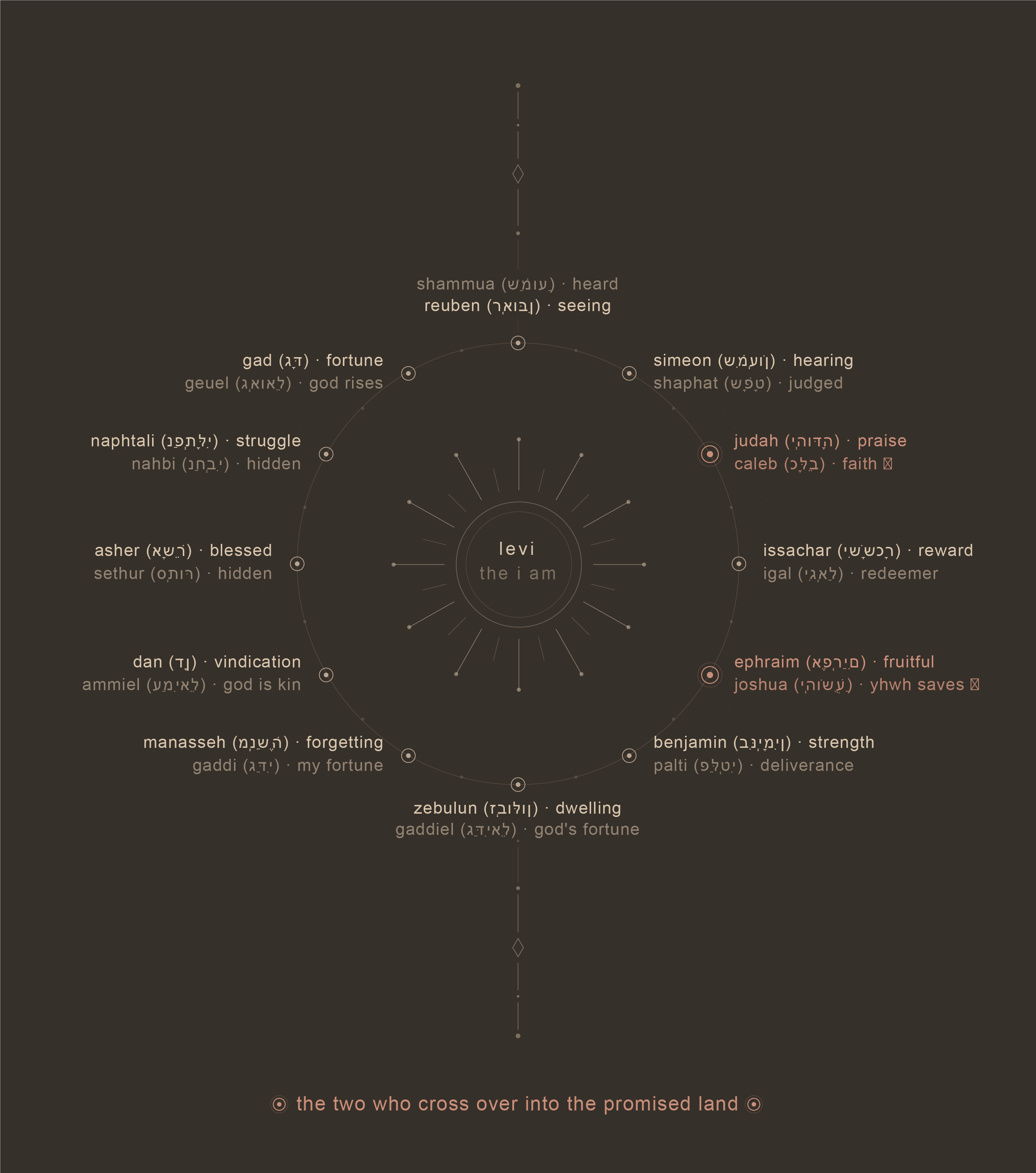
The Hebrew shemot (שְׁמוֹת), names, carries in Hebrew thought the sense of essential natures, inner characters, defining realities. What follows is not a roster. It is a psychological map of the faculties of consciousness being sent into the desired state. Each name encodes what the faculty is and what it carries into the reconnaissance.
One tribe is absent from the twelve. Levi, the priestly faculty, sends no spy because Levi has no territorial inheritance. The priestly function stands apart from the reconnaissance of the desired state. It does not need to scout the territory because its inheritance is the I AM itself. Joseph's tribe is split into Ephraim and Manasseh to maintain the number twelve.
Jacob had twelve sons, twelve tribes. But Levi was set apart for priestly service and received no land inheritance. That leaves eleven. To keep the number at twelve, Joseph's portion is given to his two sons, Ephraim and Manasseh, each becoming a full tribe. So the twelve tribes for territorial purposes are the original twelve minus Levi plus Joseph split into two.
Through AbNev's lens, the splitting carries something deeper.
Joseph is yasaf, to add, to increase continuously. He is the one faculty that cannot be contained in a single expression. The faculty of continuous increase is so abundant that it must become two. And look at what it becomes: Ephraim (double fruitfulness from affliction) and Manasseh (holy forgetting of the old hardship). These are not two random halves. They are two sides of the same increase. You cannot be doubly fruitful unless you release the memory of what the old state cost you. And you cannot truly forget the old affliction unless something fruitful is growing in its place. The two need each other. They cannot be collapsed into one faculty. They must operate as two distinct principles working in tandem.
And notice what creates the space for the splitting. Levi steps out. The priestly faculty, whose inheritance is the I AM itself (not territory, not land, not external possession), withdraws from the territorial count. And when it does, the faculty of continuous increase expands to fill the opening. The faculty whose inheritance is God creates room for the faculty of increase to double.
Twelve must be maintained. The inner kingdom requires the full assembly. When one faculty steps into a higher function (Levi's priesthood), another faculty expands to fill the structure. Nothing is lost. The fullness reorganizes itself.
Reuben sends Shammua ben Zaccur.
Reuben (רְאוּבֵן), "see, a son," from ra'ah (to see) and ben (son). The tribe whose founding name is built from the act of seeing, the faculty of perception. Genesis 29:32 confirms it: Leah names her firstborn saying "the LORD has seen my affliction." The seeing faculty sends Shammua (שַׁמּוּעַ), from shama (to hear, to listen, to obey), the heard one, the one whose voice has been received. And his father is Zaccur (זַכּוּר), from zakar (to remember, to call to mind), the remembered one. The seeing faculty dispatches a spy whose word carries weight (he has been heard) and whose lineage is memory itself (zakar, the one who calls things back into present awareness). When the faculty of perception examines the desired state, it sends a representative who carries reception and remembrance as his operative tools.
Simeon sends Shaphat ben Hori.
Simeon (שִׁמְעוֹן), hearing, from shama. The tribe whose name is the act of receptivity itself. Genesis 29:33: "the LORD has heard." Simeon's spy is Shaphat (שָׁפָט), he has judged, from shaphat (to judge, to govern, to bring into right order). The hearing faculty sends the judging one, because you cannot judge rightly what you have not first truly heard. And Shaphat descends from Hori (הֹרִי), from hor, a cave, a hollow place, the one who dwells in the rock, the interior hidden space. Right judgment emerges from the interior depth, not from the exposed surface impression. The hearing faculty's reconnaissance is conducted by right judgment that rises from the hidden, rock-enclosed place within.
Judah sends Caleb ben Jephunneh.
Judah (יְהוּדָה), praise, from yadah (to extend the hand, to give thanks, to acknowledge publicly). Genesis 29:35: "I will praise the LORD." The faculty of praise sends the spy who will not break.
The Hebrew Kalev (כָּלֵב) means dog, from kelev (כֶּלֶב). Neville read this name directly. In his lecture Eschatology: The Drama of the End, he stated: "A dog is the symbol of faith. Called 'Caleb' in scripture, he is the only one who crosses over Jordan into the Promised Land with Joshua, the Hebraic name of Jesus." The dog is not an insult. It is the symbol of faith. The faculty that follows with complete, unbroken devotion. And the I AM confirms this reading in Numbers 14:24: "My servant Caleb, because he had another spirit with him, and hath followed me fully." The Hebrew male' (מָלֵא), fully, completely, with nothing held back. The dog follows fully. The faculty of faith does not divide its counsel.
Caleb descends from Yefunneh (יְפֻנֶּה), from panah (to turn, to face toward), the one who has turned and faced. Caleb's faith is not raw instinct. It descends from the deliberate, chosen reorientation of the self toward the I AM. The wholehearted one comes from a lineage of deliberate turning.
The praising faculty sends the faculty of faith. Of course it does. Praise and wholeheartedness are the same interior movement from two directions. Praise is the extended hand toward the I AM. Faith is the unretracted following. They belong together. Of all twelve spies, Caleb alone (with Joshua) will return with the minority report. The praising faculty dispatches the faculty of complete commitment. This is not accidental.
Issachar sends Igal ben Joseph.
Issachar (יִשָּׂשכָר), from nasa (to carry) and sakar (reward, wages), the one who carries his reward. Genesis 30:18: "God has given me my hire." The faculty of expected recompense, the inner knowing that the labor of assumption produces a return. Its spy is Igal (יִגְאַל), he will redeem, from ga'al (to redeem, to act as kinsman-redeemer, to recover what was forfeited). His father is Joseph (יוֹסֵף), from yasaf (to add, to increase continuously). The reward-bearing faculty sends the redeemer descended from the ever-increasing. When this faculty examines the desired state, it looks for what can be recovered and expects continuous increase.
Ephraim sends Hoshea ben Nun.
Ephraim (אֶפְרַיִם), doubly fruitful, from parah (to be fruitful). Genesis 41:52: "God has made me fruitful in the land of my affliction. "Double fruitfulness emerging from the place of affliction, not despite difficulty but specifically within it and through it.
Its spy is Hoshea (הוֹשֵׁעַ), salvation, from yasha (to save, to deliver, to bring from the narrow, constrained space into the broad, open territory of flourishing). The same root that gives us Mitsrayim (Egypt, the double narrowness) in reverse. Hoshea carries the concept of deliverance. But as we will see at verse 16, he does not yet carry the Name. His father is Nun (נוּן), fish, the perpetually moving, self-propagating creature that cannot be still, that continues without ceasing. Salvation descends from perpetual continuation. The doubly fruitful faculty sends deliverance itself into the reconnaissance. This is the spy Moses will rename.
Benjamin sends Palti ben Raphu.
Benjamin (בִּנְיָמִין), son of the right hand, from ben (son) and yamin (the right hand, the hand of strength and favor). Genesis 35:18: Rachel, dying in childbirth, names him Ben-oni, son of my sorrow, but Jacob renames him into favor. Benjamin is the faculty born in grief and renamed into strength. Its spy is Palti (פַּלְטִי), my deliverance, from palat (to escape, to slip free from danger). His father is Raphu (רָפוּא), he has healed, from rapa (to heal, to restore to wholeness), in the perfect tense: the healing is already accomplished. The right-hand faculty sends personal liberation grounded in a completed healing. Palti's reconnaissance is conducted from the position of one whose foundation is already whole.
Zebulun sends Gaddiel ben Sodi.
Zebulun (זְבוּלוּן), dwelling, exalted dwelling, from zaval (to dwell, to honor with habitation). Genesis 30:20: "Now my husband will dwell with me." The faculty that establishes where the significant presence finally chooses to remain. Its spy is Gaddiel (גַּדִּיאֵל), God is my fortune, from gad (fortune) and El (God). His father is Sodi (סוֹדִי), my intimate counsel, from sod (the confidential conversation shared between trusted companions). Psalm 25:14: "The secret of the LORD is with those who fear him." The dwelling faculty sends one whose fortune is the I AM itself, descended from the one who has access to the divine counsel. The reconnaissance of the honored dwelling is conducted by divine prosperity from divine intimacy.
Manasseh sends Gaddi ben Susi.
Manasseh (מְנַשֶּׁה), causing to forget, from nashah (to forget). Genesis 41:51: "God has made me forget all my hardship and all my father's house. "The faculty of holy forgetting, the capacity to release the memory of affliction and servitude so completely that it no longer governs the present. Not repression. Forgetting as liberation. You cannot receive the full increase the I AM is adding if you are still fully occupied with what Egypt cost you. Its spy is Gaddi (גַּדִּי), my fortune (the fortune that is mine, that attaches to my identity), descended from Susi (סוּסִי), my horse, from sus (horse), the vehicle of swift, powerful, decisive momentum. The holy-forgetting faculty sends claimed personal fortune riding the momentum of the horse. What Manasseh releases, Gaddi's fortune rushes in to fill.
Dan sends Ammiel ben Gemalli.
Dan (דָּן), he has judged, from din (to judge, to vindicate, to execute justice). Genesis 30:6: "God has judged me," meaning God has ruled in my favor. The faculty of vindication. Its spy is Ammiel (עַמִּיאֵל), my people is God, from am (people, kinship group) and El (God). The name constructs an identity in which the I AM is not a distant sovereign but the immediate family, the blood relation, the one to whom the bearer belongs by nature. His father is Gemalli (גְּמַלִּי), from gamal, which in its verbal sense means to deal fully with, to bring to mature completion, to wean. The vindication faculty sends one who is already in family relationship with the I AM, descended from complete maturity. There is nothing preliminary about Ammiel's relationship to God. It is kinship. It is complete.
Asher sends Sethur ben Michael.
Asher (אָשֵׁר), happy, blessed, from ashar (to go straight, to advance, to be happy). Genesis 30:13: "The daughters will call me happy." The faculty of felt blessedness. Its spy is Sethur (סְתוּר), hidden, concealed, from satar (to hide, to keep secret, to conceal). His father is Michael (מִיכָאֵל), who is like God?, from mi (who) and k (like) and El (God), the rhetorical question that is its own answer: nothing is comparable to the I AM. The happiness faculty sends a spy whose work is done in concealment, descended from the incomparability of God. The faculty of felt well-being conducts its deepest reconnaissance below the surface, invisible to the congregation's panic.
Naphtali sends Nahbi ben Vophsi.
Naphtali (נַפְתָּלִי), from pathal (to twist, to wrestle, to struggle until prevailing). Genesis 30:8: "With wrestlings of God I have wrestled with my sister, and I have prevailed." The faculty of sacred struggle, the one that contends and refuses to release until the blessing is extracted. The same pathal quality that defines Jacob at the Jabbok, wrestling all night until the name changes. Its spy is Nahbi (נַחְבִּי), hidden, from chaba (to hide, to conceal oneself, to withdraw into hiding). The second hidden spy in the list. Two of the twelve elevated faculties (Sethur and Nahbi) carry concealment as their essential name. The inner reconnaissance of the desired state has a hidden dimension, a quality of operation that functions beneath the surface of the public report. His father is Vophsi (וָפְסִי), likely from yasaf (to add, to increase), the same root that underlies Joseph. The wrestling faculty sends the hidden one from increase. The wrestling happens in secret. The increase arrives from the same root as the ever-adding. What the sacred struggle conceals, the adding principle supplies.
Gad sends Geuel ben Machi.
Gad (גָּד), fortune and troop. The name carries a textual tension: gad as favorable destiny and gad as advancing raiding band. Genesis 49:19 plays on both: "Gad, a troop shall overcome him, but he shall overcome at the last."Gadis the forward-advancing faculty that is overcome and yet prevails. Its spy is Geuel (גְּאוּאֵל), majesty of God, from ga'ah (to rise up, to be exalted) and El (God). The same ga'oh ga'ah of Exodus 15:1, the victory song at the sea: "He has triumphed gloriously, he has risen up magnificently."Geuel carries in his name the victory declaration of the Exodus itself. His father is Machi (מָכִי), from makah (to strike, to smite), the verb used throughout the plague narratives. The fortune faculty sends the majestic rising of the I AM descended from the striking power that broke Pharaoh's grip. When the Gad-faculty examines the desired state, it carries the victory song and the liberation blow as its operative tools.
The Renaming | Numbers 13:16
"These are the names of the men which Moses sent to spy out the land. And Moses called Oshea the son of Nun Jehoshua."
The text pauses. After listing all twelve spies, the narrative stops and performs a summary gesture: elleh shemot (אֵלֶּה שְׁמוֹת), these are the names, the same phrase that opens the book of Exodus, where it introduces Israel's descent into Egypt and the beginning of the bondage. Here it introduces the moment before the ascent into Canaan. The names-formula appears at both the entry into bondage and the threshold of liberation. The I AM's attention to the shemot (the essential natures) is present at both turning points.
Then the renaming. The verb is wayyiqra (וַיִּקְרָא), from qara, to call, to name, to define the essential nature. This is the verb of Genesis 1:wayyiqra Elohim la'or yom, "and God called the light Day." The naming in Genesis 1 is the creative act itself. What is named becomes what it is named. Moses uses the same verb to rename one spy. This is not a nickname. It is a creative act of naming, the same verb by which the I AM called the light into its identity at the foundation of creation, applied to a human faculty that must become what it is about to be named.
Hoshea (הוֹשֵׁעַ) means salvation, from yasha alone. The faculty carries the concept of deliverance as an abstract quality. It is real. It is valuable. But it does not yet name the one who saves. Hoshea can describe what happens. He cannot yet name who causes it to happen.
Yehoshua (יְהוֹשֻׁעַ), Joshua, means YHWH saves. The addition is the divine Name itself, the Tetragrammaton, inserted directly into the name at its opening. What was yasha (salvation as concept) is now YHWH-yasha (the I AM as active, present-tense, causative agent of deliverance). The noten of verse 2, the I AM's present-tense giving, is now written into the identity of the one who will lead Israel into Canaan.
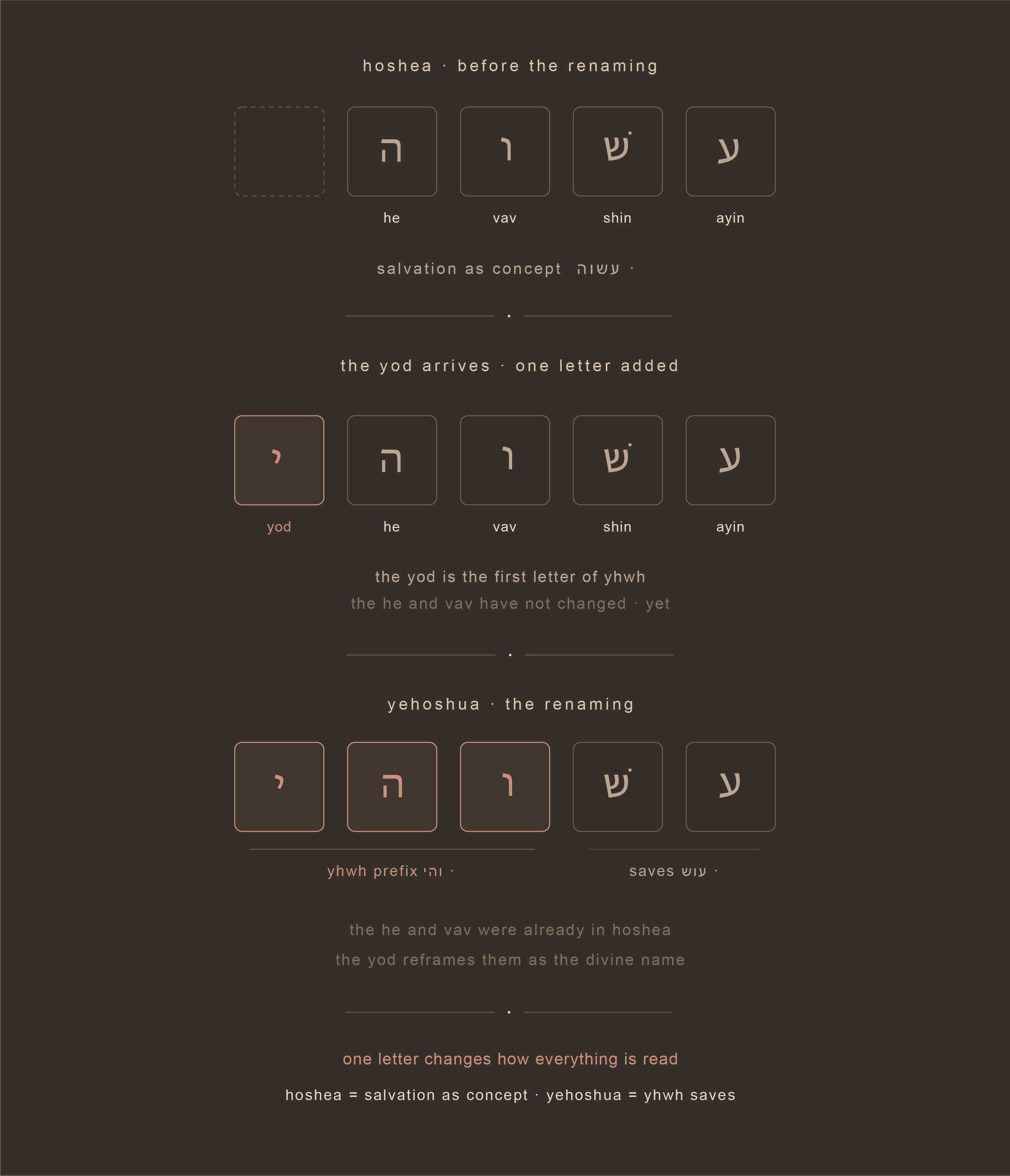
Neville confirmed this identification directly: "The word 'Jesus' is the anglicized form of the Hebrew word 'Joshua' which means 'savior.'"Joshua is Jesus in Hebrew. The Christ-pattern. The I AM moving through a human faculty into full possession of the promised state.
Of all twelve, Moses renames only one. He does not rename Caleb. He does not rename Gaddi or Geuel or Ammiel.He renames only the spy of the doubly fruitful faculty, only the faculty of deliverance, only the one who will ultimately succeed where Moses himself does not go. The renaming is surgically precise.
The psychological instruction is demanding. You may carry the concept of your desired state for years. You may know that health is possible, that abundance is real, that the relationship you want exists somewhere. Hoshea is not wrong. Salvation is real. But Hoshea does not lead Israel into Canaan.Joshua does. The faculty that crosses the Jordan is the faculty that has had the divine Name added to its essential identity, the faculty that no longer carries salvation as a concept but carries YHWH as active, present-tense, causative agent built into who it fundamentally is.
This is what Abdullah did to Neville. In his lecture Thinking Fourth-Dimensionally, Neville recounted it directly: "Abdullah said to me, 'If you really want to go? You are in Barbados.'" And then: "I wavered, but he remained faithful to the assumption that I was in Barbados and had traveled first class. "Neville was Hoshea. He carried the concept of deliverance. Abdullah performed the renaming. He added the I AM's active present-tense giving to Neville's identity and would not let the old name reassert itself. "You are in Barbados" is the wayyiqra of verse 16. Abdullah was performing the creative naming act on Neville's inner faculty of deliverance. He was adding the divine Name.
Joshua's lineage does not change with the renaming. He remains ben Nun, son of the fish, the perpetually propagating, continuously moving, self-renewing force.What changes is not the source of his power. What changes is whose Name is attached to the expression of that power.
Disclaimer: This is not academic biblical analysis. I am using the Neville and Abdullah lens like a magnifying glass, turning it on parts of the Bible they may not have explicitly touched, to see what else is revealed when scripture is read as a living roadmap of inner consciousness rather than as historical record. Take what serves you, leave what doesn't. Feedback and criticism is welcomed, with respect!