stand alone deep dives
In Part One, we established through Neville's reading that John the Baptist represents the natural mind that prepares but cannot enter the kingdom, while Christ represents the awakened imagination that alone can occupy the state of the wish fulfilled. Before we arrive at the beheading scene in Part Three, the chapter opens with a different kind of inner drama. Mark 6:1-16 walks us through what happens before the rational mind is finally removed from the throne. The awakened imagination returns to its hometown (the old self), encounters the resistance of fixed identity, and then commissions its faculties to spread the new state outward.
Scene One: The Prophet in His Own Country (Mark 6:1-6)
"And he went out from thence, and came into his own country; and his disciples follow him. And when the sabbath day was come, he began to teach in the synagogue: and many hearing him were astonished, saying, From whence hath this man these things? and what wisdom is this which is given unto him, that even such mighty works are wrought by his hands? Is not this the carpenter, the son of Mary, the brother of James, and Joses, and of Juda, and Simon? and are not his sisters here with us? And they were offended at him."
The drama opens with the awakened imagination returning to its hometown. The Greek word for "own country"(πατρίς, patris) means fatherland, the place defined by one's lineage and origin. Read through AbNev's lens, the patris is not Nazareth as a geography. The patris is the territory of fixed identity inside the consciousness. The place that knows you by your old name. The inner council that says "we know what you are, we know what you have always been."
Neville taught about this state directly. In The Power of Awareness, he wrote that you must abandon your present conception of yourself to move into the new state. The old self always argues for its own reality. It cites every piece of evidence available. It invokes every familiar voice. This is the patris. The Christ in you cannot do many mighty works there, not because the power is less, but because the soil refuses the seed.
Look at what the hometown does. They see the mighty works. They cannot deny the evidence. But instead of opening to it, they close around it. "Is not this the carpenter? The son of Mary? The brother of James?" The familiar identifications spring like a trap. The Greek for "offended"(σκανδαλίζω, skandalizō) carries the sense of stumbling on a snare, the trigger-stick that springs the trap closed. Familiarity itself becomes the snare. The fixed category activates, and belief cannot enter.
Notice the directional language: "offended at him," not "offended by him." The Greek preposition (ἐν, en) is locative. The offense is located in him, occasioned by him, but it does not originate from him. He does not cause the stumbling. He is the ground where the stumbling happens. The snare is in them.
"And he could there do no mighty work, save that he laid his hands upon a few sick folk, and healed them. And he marvelled because of their unbelief."
Notice the precise wording. He could not. Not he chose not to. Not he decided to withhold. The Greek (οὐκ ἐδύνατο, ouk edunato) means he was not able. The creative power requires the cooperation of the receiving consciousness to fully express. When the inner soil is compacted by the certainty of the old story, the seed of the new assumption cannot fully take root.
This is Abdullah's teaching made plain. When Neville said "I have no money for the ticket," Abdullah did not engage the patris. He did not debate the evidence. He simply said "you are already in Barbados." Abdullah refused to enter the territory of familiarity because he knew that every conversation about the current reality was a return to the patris that would close the trap and render the new assumption inoperative.
The awakened imagination marvels at the unbelief, then departs. He does not argue with the hometown. He goes round about the villages, teaching elsewhere. The patris does not get the final word. But neither is it conquered by debate. It is simply left behind as the imagination moves into a territory where the new state can be received.
The principle here is structural. Belief is not a passing feeling. It is the inner soil that must be fertile for the dunameis to fully manifest. The feeling of the wish fulfilled is the seed. Belief is the soil that receives it. Without the soil, the seed has nowhere to root.
The Greek (δυνάμεις, dunameis) is the plural of dunamis. It means inherent power, the capacity that belongs to the nature of the one who has it. Not authority granted from outside. Not borrowed force. The capability native to the being itself. In the Gospels the plural refers to the visible eruptions of that inner power into outer circumstance. Read through AbNev's lens, dunameis is imagination operating at full pressure. The I AM does not receive dunameis. The I AM is dunameis. Where the inner soil is not yet fertile, the work goes elsewhere. The imagination does not argue with the patris. It moves to parts of the mind where the new state can be received.
Scene Two: The Twelve Sent Forth (Mark 6:7-11)
"And he called unto him the twelve, and began to send them forth by two and two; and gave them power over unclean spirits."
The awakened imagination, having departed the patris, now does something specific. It calls its twelve close. It commissions them. It sends them out.
Neville read this scene directly. In Your Faith Is Your Fortune, he taught: "The twelve disciples represent the twelve qualities of mind which can be controlled and disciplined by man. These twelve qualities in man are potentials of every mind." The twelve are not historical missionaries. They are the complete set of psychological faculties available to the awakened consciousness.
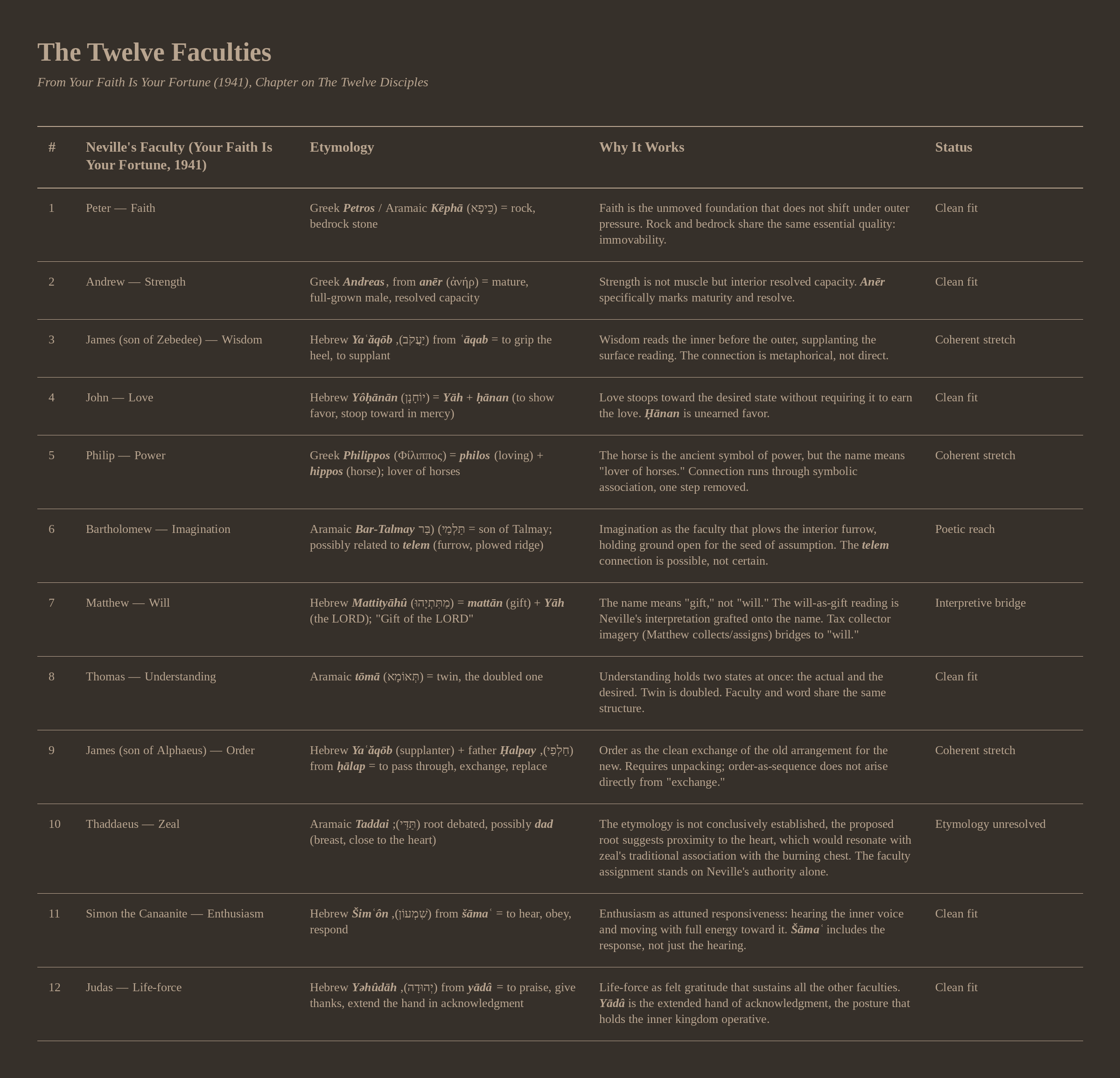
These twelve are commissioned. The Greek for "send forth" (ἀποστέλλω, apostellō) means to dispatch with the full authority of the sender. The faculty is not sent out in its own name. It carries the authority of the awakened imagination that commissioned it. Each quality of mind, when properly commissioned, operates in the world clothed in the authority of the awakened imagination, which is the I AM aware of itself.
The twelve are sent two by two. In the Hebrew tradition (Deuteronomy 19:15), a matter is established by the testimony of two witnesses. The faculties pair as they go out. Imagination paired with feeling. Will paired with attention. Conviction paired with action. No faculty operates effectively alone. Each one needs its complement to establish its testimony in manifestation.
"And commanded them that they should take nothing for their journey, save a staff only; no scrip, no bread, no money in their purse: But be shod with sandals; and not put on two coats."
The commissioning is austere. The faculties are stripped of provision before they are sent. They carry only the staff, the rod of authority, and nothing else. No bag of accumulated past evidence. No bread of sensory confirmation. No money for worldly negotiation.
Sandals on the feet, but only sandals. The Greek (ὑποδήματα, hypodēmata) means literally "that which is bound under." The sandal also marked status in the ancient world. To carry another's sandals was to occupy the lowest position in the household, as John the Baptist confessed when he said he was not worthy to loose the sandal of the one coming after him. The rational mind knows it cannot carry the assumption that belongs to the awakened imagination. It is not equipped for it. The sandal here is the assumption currently governing the walk. The faculty travels bound under the authority of the awakened imagination that commissioned it, not bound under the old assumption it left behind in the patris.
And one tunic, not two. The chitōn (χιτών) is the inner garment worn directly against the skin, beneath the outer cloak. It is the foundational layer of dress. To lose the chitōn was to be naked. To carry a second one is the psychology of contingency, the spare identity packed in case the first one fails. Two chitōnes worn at once means neither sits cleanly against the skin. The instruction forbids it. The old identity must be released completely, not held in reserve as a place of refuge. Burn the ships.
Read through AbNev's lens, this is the psychology of radical dependence on the assumption itself. The faculties operate not on what the senses report, not on what experience says is possible, not on what the world offers as currency. They operate on the authority of the I AM that sent them. This is Abdullah's instruction made explicit. He did not say "you are in Barbados, but if it does not work out we will figure something else out." He said "you are in Barbados." One sandal binding. One tunic against the skin. The authority of the assumption already made, with no backup assumption packed for the road.
"And whosoever shall not receive you, nor hear you, when ye depart thence, shake off the dust under your feet for a testimony against them."
The Greek for "shake off" (ἐκτινάσσω, ektinassō) means to shake out thoroughly, decisively. The image is the traveler at the threshold of the house, beating the dust from his cloak before moving on. The dust is the residue of the rejecting territory. If the faculty carries that residue into the next house, the next house receives a contaminated assumption, met before it has even arrived by the verdict of the room that refused it.
The instruction reads cleanly on two levels.
Within the inner life, the faculties move through territory. Some rooms hold climates of belief that receive the new assumption. Some are sealed against it. The instruction is not to force the sealed door. It is to move clean. Where the inner room rejects the new state, the faculty does not bash the door down. It does not negotiate. It does not stay to convince. It shakes off the dust and finds a room where the new assumption can be received.
The same instruction applies outwardly to the teaching itself. Jesus repeats it in Matthew 7:6: do not cast pearls before swine. The lens is not for every mind. The reading of scripture as living psychological roadmap is not received by a consciousness committed to scripture as history. That is not insult, it is information. The teaching does not lower itself to be acceptable to the room that has sealed against it. It moves on. It finds the rooms where the work can take root.
This is Abdullah's method made structural. He did not argue Neville out of his lack belief. He simply refused to enter that room with him. He stayed in the Barbados room. The dunameis flow to wherever the medium is open. The closed medium will open in its own time, or it will not, but it is not where the work happens today.
Scene Three: The Three Operations (Mark 6:12-13)
"And they went out, and preached that men should repent. And they cast out many devils, and anointed with oil many that were sick, and healed them."
The twelve faculties go out and execute three specific operations. Each operation has a precise Greek verb, and each one corresponds to a specific stage of how the new state takes hold in consciousness.
The first operation is preaching. The Greek (κηρύσσω, kēryssō) is not teaching, not conversing, not debating. It is heralding. The kēryx in the ancient world was a herald who announced the king's decree with formal authority. The territory was expected to reorganize itself around the announcement. The herald did not invite discussion. He announced.
What the faculties herald is repentance. The Greek (μετανοέω, metanoeō) is built from meta (after, beyond) and noeō (to perceive, to think). It means a directional reversal of the mind. To turn the inner gaze from one way of perceiving to another.
Neville was absolute on this. In Your Faith Is Your Fortune, he wrote: "To repent is to think differently, to change your attitude toward that which formerly claimed your attention." Repentance in Neville's reading has nothing to do with guilt or moral remorse. It is purely cognitive and directional. You think differently about what you have been thinking about. You turn the mind from the old perception to the new.
This is what Abdullah did with Neville. He did not ask Neville to feel guilty about his poverty. He demanded that he think differently about his location. "You are already in Barbados." That is metanoeō delivered as a sovereign decree. Stop perceiving lack. Perceive arrival. The herald announces. The mind turns.
The second operation is casting out. The Greek (ἐκβάλλω, ekballō) means to throw out forcefully. Not gentle persuasion. Not negotiation. Forceful expulsion. The objects being cast out are described as "devils." The Greek(δαιμόνια, daimonia) read psychologically refers to the autonomous thought-systems that have taken up residence in consciousness and operate as though they have independent authority. Beliefs that have hardened into self-directing voices. Limitation narratives that seem to speak from a separate self.
These are not invited to leave. They are cast out. The new ruling consciousness, operating through the commissioned faculties, expels the contradicting beliefs from the inner kingdom entirely.
The third operation is anointing. The Greek(ἀλείφω, aleiphō) means to apply oil tactically, distinct from the ceremonial chriō. The oil is olive oil (ἔλαιον, elaion), the product of the olive press, the substance that emerges only under pressure. The faculties anoint with oil and heal.
Read through AbNev lens, this is the application of the felt presence of the new state directly to the wounded place. After the herald has announced and the contradicting belief has been expelled, the faculty applies the feeling of the fulfilled state. Not as proclamation. Not as expulsion. As gentle, direct, intimate application. The healing happens at the point where the new feeling touches the place that was sick with the old belief.
These three operations are the complete manifestation method described mechanically.
➳ Announce the new state with the authority of the I AM.
➳ Expel the contradicting thought-system that wants to keep ruling.
➳ Anoint the consciousness with the feeling of the fulfilled state.
Disclaimer: This is not academic biblical analysis. I am using the Neville and Abdullah lens like a magnifying glass, turning it on parts of the Bible they may not have explicitly touched, to see what else is revealed when scripture is read as a living roadmap of inner consciousness rather than as historical record. Take what serves you, leave what doesn't. Questions and criticism are welcomed, with respect.