stand alone deep dives
In Part Three, the formed self heard the name spreading and recognized the rising power as the very faculty it once demoted. Then the text turned backward into memory. Now we enter that memory and walk through the architecture of the suppression itself: how the formed self seized and bound the rational faculty, what the indictment was, who Herodias really is, and why the kingdom has been paying the price ever since.
Scene Three: How the Suppression Was Built (Mark 6:17-20)
Movement 1: How the Seizure Happened
"For Herod himself had sent forth and laid hold upon John, and bound him in prison for Herodias' sake, his brother Philip's wife: for he had married her."
The descent into memory begins with the mechanics of the seizure itself. The verse names four sequential operations, each with its own Greek word, and then it names the cause.
The first word is αὐτός (autos), the intensive personal pronoun. Herod himself. Not his servants. Not his court. Not the machinery of the kingdom acting at arm's length while he kept his hands clean. The formed self personally, directly, by its own decision, initiated the seizure. This is the point of the word: the formed self initiated the seizure of reason from its own center. The text places the responsibility squarely there, with no one else to blame.
The second word is ἀποστέλλω (apostellō), to send forth on a commission with full authority. This is the same word that opened the commissioning of the twelve disciples in Mark 6:7, when the Christ-state apostellō-d its faculties outward to announce, expel, and anoint. Now in Mark 6:17 the same word is operating in the opposite direction. The Christ-state sends forth to liberate. The formed self sends forth to contain. What you send forth carries the nature of the center it proceeds from. Mark chapter 6 is showing both directions of the same authority in the same chapter, so the reader cannot miss the point. The question is never whether you have the power. The question is from what center you are commissioning it.
The third word is κρατέω (krateō), to seize and hold fast with sustained muscular force. Not a momentary grab. The Greek root carries the sense of ongoing expenditure of strength to maintain a grip on something that would otherwise move freely. The formed self did not merely contain the rational faculty. It gripped it continuously, expensively, with sustained force.
Read through AbNev's lens, krateō reveals the cost of the suppression. The grip never gets to relax. Every unit of energy the formed self spends holding reason down is energy it is not spending on creating. The kingdom is quietly draining itself, paying a price just to keep one voice from speaking. Constraining reason is not a single act. It is a permanent expenditure of energy.
The fourth word is δέω (deō), to bind. The Greek carries two senses at once. The literal sense is to fasten with chains. The figurative sense is to put someone under a "you may not" order, like saying "my hands are tied." Both senses are in play here. The rational faculty has been fastened in place, and at the same time it has been placed under prohibition. It may not govern. It may not direct the inner kingdom. It is alive, still capable of speaking, still being heard, but it is forbidden to rule. The krateō (sustained grip)was the act of seizing. The deōis the condition that resulted. Reason is now in a state of chained existence under a "you may not lead" order from the formed self.
The rational faculty is the builder of the formed self. It is what constructed the current arrangement, defended it, justified its legitimacy. We established in Part One that everyone passes through the state of consciousness named John before entering the state of Christ. Reason is how the formed self knows itself. It is the faculty that built the kingdom Herod now rules. But reason has already identified a power greater than itself. John himself declared it: "There cometh one mightier than I after me, the latchet of whose shoes I am not worthy to stoop down and unloose" (Mark 1:7). The rational faculty, by its own testimony, has recognized that something greater than reason is at work. And having recognized that, it can no longer defend the old kingdom with a clean conscience. So it turned, and began naming the arrangement as wrong. The formed self is not silencing a faculty that broke. It is silencing a faculty that defected. The suppression is self-preservation. The survival instinct (Herodias) and the old ruling consciousness need reason quiet because reason has stopped defending them and started accusing them.
The place where the binding happens is named with the Greek word φυλακή (phylakē). The English translation says "prison," but the Greek root is not cage. The root is watching. The phylakē is a watched place, a place of surveillance, a place of custody where the prisoner is kept under continuous observation. The watching runs in both directions. The formed self watches the rational faculty to keep it from speaking against it. The rational faculty, from inside the cell, can still see the formed self exactly as it is. The chains stopped John from acting but did not stop John from seeing. His vision of the kingdom is undimmed. This is why, a few verses later, Herod can still hear him gladly even while keeping him bound. From inside the watched cell, the rational faculty still sees clearly and speaks what it sees.
Then the verse names the cause of the entire seizure. The Greek preposition διά (dia) with the accusative means "because of." It names the structural reason behind an action. The seizure happened dia Herodias. Because of Herodias. Not because John was a political threat. Not because of theological disagreement. Because Herod married Herodias. The marriage caused the imprisonment. John was speaking against the marriage. So the marriage produced the imprisonment of John as a direct result. Cause and effect in plain order.
And here the verse tells us what the marriage actually was. The Greek does this work with three words in succession. γαμέω (gameō) is the word for marriage, the formal public covenantal union of two people into one household. Not a casual relationship. A binding covenant with mutual claim. ἀδελφός (adelphos) is brother, one born of the same source, sharing the same blood. And γυνή (gynē) is wife, the partner with full claim on the household and full access to the most private decisions of the home. Together these three words say one thing: Herod has entered into a binding covenant with a woman who properly belonged to his brother. He has made her his wife. She now shares his throne, his household, and his decisions.
Read through AbNev's lens, this is the architecture of the inner kingdom in disorder. The inner kingdom has a natural order. The I AM at the top, pure awareness. Imagination then reason underneath, serving the I AM. Desire underneath them, providing motion and direction. The body and senses underneath that. Each faculty has its proper level. Each one does its proper job. Desire is the engine that moves the system. It is not the steering wheel. Desire informs the consciousness where it wants to go. The ruling consciousness decides whether to go there. That is the design.
What Herod has done in marrying Herodias is wed the ruling consciousness to its survival instinct. Herodias represents the part of the self whose entire function is to keep the current system of arrangement alive and to resent whatever threatens it. In the proper order she has no seat at all. She is not a faculty that governs. She is the self-protective reflex of a state that does not want to die. By marrying her, the formed self has taken that reflex and made it co-ruler. She now shares the throne, the inner world, the most private decisions. The instinct that should answer to the ruling consciousness is now sharing the seat of rule with it. The arrangement is no longer governed by what is true. It is partly governed by what keeps the existing self in place.
The next reading goes one layer deeper. The wife was previously Philip's. The Greek name Philippos breaks into philos plus hippos, lover of horses. This is a coherent stretch through AbNev's lens, not a lexical fact. Read it as offered and see if it lands. If it doesn't, the architecture still holds without it. Philip can be read as the carnal-power mode of the same consciousness, the lower expression of the formed self organized around physical force and self-preservation. He is the brother because he is born of the same root self. He is the one who previously held this survival instinct, because the instinct to defend and preserve naturally belongs at that lower, bodily level, guarding the organism. What Herod has done is take the self-preservation reflex that properly operates down at the level of physical survival and elevate it to share the throne of the aware ruling consciousness. The instinct that belonged to the body's guarding has been promoted to co-rule the awakening consciousness. What was meant to protect the organism has been made spouse to the king, and now it defends not only the body but the old self.
This is the disorder John has been naming from inside the prison, and it is worth stating plainly, because it is the exact place most people go wrong with this teaching.
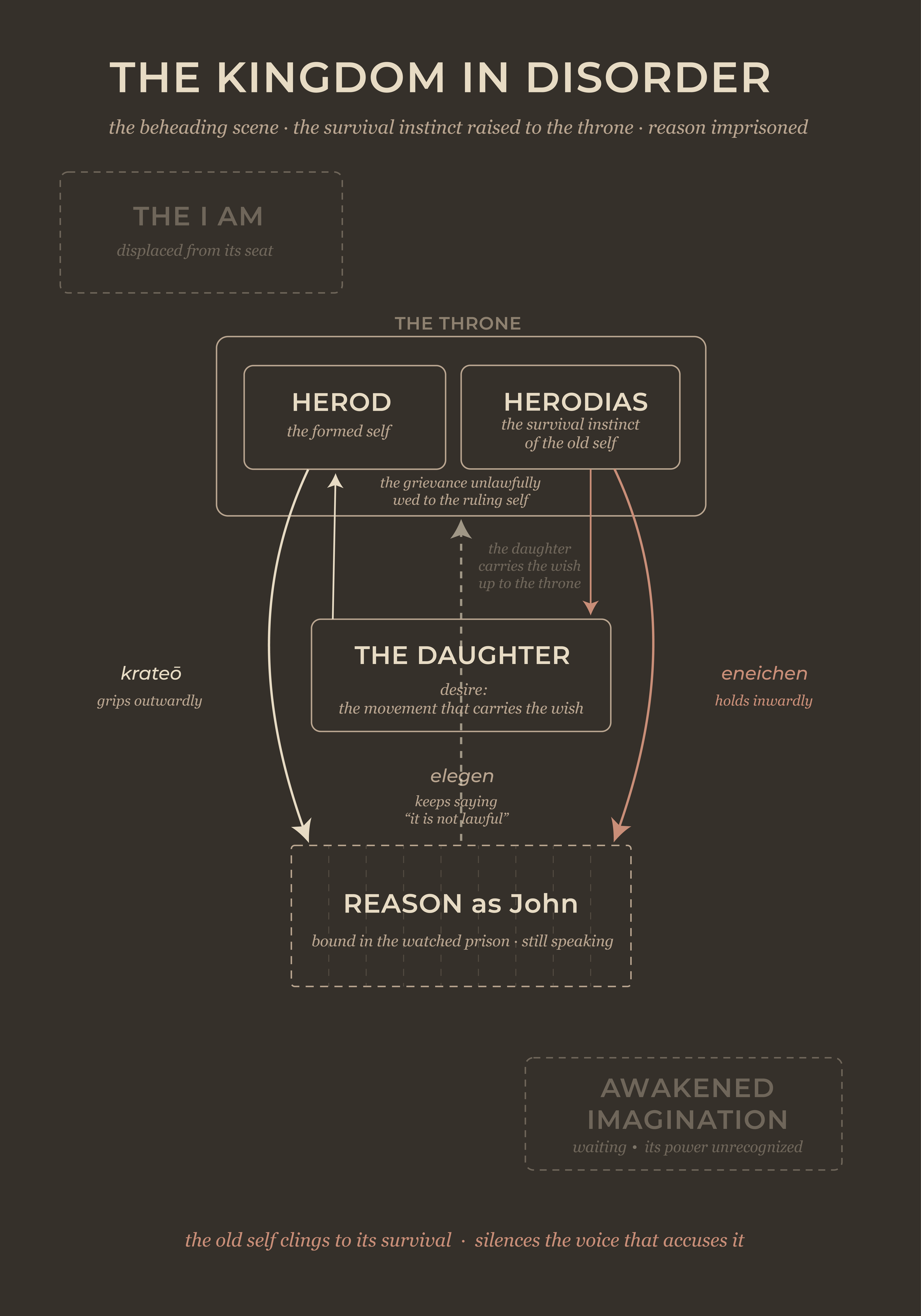
The problem is not desire. Desire is part of the design. Desire is the engine. It is information. It tells the consciousness what is closest to the surface, what is most ready to be moved toward. Neville described desire as the messenger, showing you which state is nearest. In its proper place, desire is essential. Without it, nothing moves.
The problem is what happens when the survival instinct hijacks desire. Desire's nature is to desire, it is what compels the consciousness to move. That is its whole function. It reaches. So when desire is informing the I AM in the proper order, the desire is useful: it points to a direction, and then the I AM assumes the state and acts from that having state. But when the survival instinct sits on the throne next to the old ruling consciousness, it pulls desire into its current. The reflex of the survival instinct is to do one thing, preserve the existing state of consciousness. A consciousness caught in the pull of that survival reflex stays locked in perpetual wanting and that incessant wanting under the old ruling state never allows the state of consciousness to change, and a state that never changes never dies. So desire, which was designed to point toward what is ready to emerge, gets redirected into endless reaching. The endless reaching dislocates the being. The kingdom reaches forever and never arrives because desire is caught in the whirlwind of an instinct that can only do one thing: instinctively preserve the old state of consciousness.
This is the vending-machine distortion. People hear that imagination creates reality and they turn the teaching into appetite management. They build a practice around obsessive wanting. They treat the I AM like a vending machine and try to extract outcomes through the sheer force of their desire.The harder they try, the more they reinforce the wanting, and the wanting is the state of not-having.So the not-having hardens. What looks like awakening is actually the survival instinct ruling through desire. Herodias has hijacked the engine.John is imprisoned and silenced because he keeps saying the kingdom is out of order. Imagination is not actually awakened, only colonized by appetite and put to work in the service of getting. And inadvertently the disorder further cements the old self.
Desire is the messenger. The messenger is not meant to rule from the throne. The messenger delivers the message and points to the destination. But when the survival instinct of the old self is the one sitting on the throne, it intercepts the messenger and sends the being running in circles. The message never bears new fruit because it is still the striving of the old self. This displaces the I AM from assuming a new state. Later in the scene, the text shows us something worth noticing. The daughter danced on her own (Mark 6:22). She did not go to Herodias first. She did not ask for permission to move. It was only after Herod made a vow to her that she went to her mother to ask what to request (Mark 6:24). Read through AbNev's lens, desire moved first, on its own. The survival instinct did not initiate the movement.
Neville taught the correction constantly. In The Power of Awareness, he wrote: "Nothing. It is a delusion that, other than assuming the feeling of the wish fulfilled, you can do anything to aid the realization of your desire." The work is not in the wanting. The work is in the state. He titled the foundational little book Feeling Is The Secret, not Desire Is The Secret. The center of operation is the state you are in, not the thing you are reaching for. Desire shows you which state is closest. Feeling is how you enter it. Two different operations. One is information. The other is assumption. The disorder is using desire to do the work that only feeling can do.
Another distortion people struggle with is not taking action. Neville says, "Continue to imagine what you want until you have actually obtained it. You do nothing else to obtain your desire. If it is necessary to take some action, you will be led to do so in a normal, natural manner." Well then the reader must ask themselves, is it necessary to take action? What type of action would the person I am now assuming to be take? If reason says take action, then the correct application of this teaching is to take action from the premise of already having the desire which removes the excessive and obsessive striving as though you don't have it. What Neville was attempting to communicate is the conscious order in which we need to operate. In other words, instead of doing → to have → to be, he was saying for us to operate from being → to doing → to having. He was attempting to inform us of the conscious psychological hierarchy.
And the rational faculty, John, is in the kingdom precisely to keep the order in line. When reason sees Herodias elevated above her proper level, it speaks. It cannot help but speak. That is what reason does. It names the disorder when it sees it. Silencing reason does not change the disorder. The only thing the imprisonment accomplished was muting the voice that kept pointing at the problem.
Reason is demoted from headship, NEVER destroyed, and that distinction is not academic. It is a safeguard. Any teaching, any teacher, any movement that tells you to switch your reasoning off entirely is not awakening you. It is disarming you.This is how people end up surrendering their judgment to someone who told them their own mind was the obstacle to their enlightenment. Do not abandon it. Demote reason from the throne, yes. Discard it, never. Likewise, when applying the principles of this teaching to your life, it is important to imagine, feel and then ask yourself (reason) what is the proper action to take as the person I am imagining myself to be.
Abnevariel is dedicated to expanding on Abdulla and Neville's work, that is why the mission statement of this project acknowledges that "This work is not about manifestation, it is about inner transformation which leads to ease in manifestation." This work is about having a deeper understanding of ourselves. This work is not meant for surface level study to then be used for obsessive manifestation. The Beheading is a piece about the inner transformation. It is showing what has to happen to dismantle the old kingdom where the old state and survival instincts rule. The awakening is not getting desire what it wants. The awakening is putting desire back in its proper place so the I AM operating through feeling and imagination can take the throne again.
Movement 2: The Indictment (Mark 6:18)
"For John had said unto Herod, It is not lawful for thee to have thy brother's wife."
The verse looks small. A single sentence of speech. But the Greek tells us something the English flattens. The verb translated "had said" is ἔλεγεν (elegen), the imperfect tense of legō. The imperfect tense in Greek is the tense of ongoing, repeated action. In plain terms, it does not mean John said this once. It means John kept saying it. From the moment the formed self took the brother's wife as ruling partner, the rational faculty has been speaking the same verdict, over and over, without cessation.
This is what the krateō (sustained grip) and the deō (binding) of Movement 1 have been holding against. The formed self gripped the rational faculty and bound it in the watched place not to silence a single statement but to contain a continuous voice. The chains did not stop the speaking. From inside the phylakē (the watched prison), within the internal kingdom of the consciousness, John keeps saying it. And every moment the formed self maintains the constraint is a moment the rational faculty is still speaking the indictment.
The indictment itself is οὐκ ἔξεστιν (ouk exestin), "it is not lawful." The basic meaning is uncontested: not permitted, not within the bounds of what is right. Read through AbNev's lens, the rational faculty is not citing a legal code here. It is not appealing to Mosaic law about a man marrying his brother's wife, though that parallel exists in the historical layer. John is naming a structural disorder. The arrangement does not belong to the nature of the inner kingdom as it was designed to operate. The survival instinct wearing the crown is not an expression of what the I AM actually is. The exestin is a statement about the right order of being, not about legal infraction.
The indictment is addressed personally. The Greek dative σοι (soi) means "for you," directed at one specific person in one specific situation. John does not say "it is not lawful for a king to marry his brother's wife" as a general principle the formed self could absorb as abstract instruction. He says it is not lawful for thee, for you specifically, in this arrangement, with this woman, right now. The personal address is what gives the indictment its force. John does not say this is wrong in general. He says this is wrong for you, here, now. The rational faculty names the disorder directly to the one maintaining it.
The Greek tense tells us what John is indicting. ἔχω (echō) is present tense of having, holding, keeping in ongoing grip. Not the tense of "you married her once in the past." The present tense. What you are currently holding, maintaining, keeping in place right now. John is not indicting the historical act of the wedding. He is indicting the ongoing maintenance of the arrangement. The marriage is not a closed event. It is a present condition the formed self is continuously holding in place.
The arrangement is named one more time at the end of the verse. The brother's wife. The genitive τοῦ ἀδελφοῦ (tou adelphou) means "of the brother," the grammar of proper belonging. The survival instinct belongs to Philip. To the carnal-power mode. To the lower expression of the same root self. She has been taken from where she lawfully belongs and installed where she does not. The grammar names the displacement directly. And the indictment cannot be argued with, because it is not making a legal claim. It is naming a thing that is genuinely out of order.
The formed self cannot answer the indictment without dismantling the arrangement. And it cannot maintain the arrangement without continuing to hear the indictment. Read through AbNev's lens, this is a stalemate that cannot resolve from inside its own logic. Something has to break it from outside.
Movement 3: The Quarrel of Herodias (Mark 6:19)
"Therefore Herodias had a quarrel against him, and would have killed him; but she could not."
The verse opens with the Greek conjunction ὁ δέ (ho de), a mild adversative that means "but" or "now." It is the hinge. Verse 18 gave us John continuously speaking the indictment. The ho de pivots the camera to show how the survival instinct specifically reacts to that continuous speech. The hinge matters because Herod's reaction and Herodias' reaction are going to be different, and the text marks the divergence at the level of grammar. Same indictment. Two responses. The formed self responds with fear and dependence, which we will see in Movement 4. The survival instinct responds with the verb the text is about to give us.
First, who Herodias is, read through AbNev's lens. If John is the rational faculty that names the disorder, Herodias is the part of the self that holds position on the throne and resents whatever voice threatens that position. The Greek tells us this directly. The word translated "had a quarrel" is ἐνεῖχεν (eneichen), a compound of en (within) plus echō (to hold). In this construction, with the dative "against him," it carries the specific sense of harboring a sustained grudge directed at a named target. This is not a disagreement that flares and passes. This is held hostility. The text names Herodias as the one who holds inwardly against the voice that keeps speaking.
It is worth being clear about where this held hostility comes from. This is not self-hatred. The I AM has nothing to defend. The resentment comes from the part of you that is invested in the current identity. Reason keeps naming that identity as out of order. The grievance is the arrangement defending its own life. It does not resent itself. It resents the voice that threatens its continuation.
And here a mirror across the prison wall becomes visible. In Movement 1, Herod krateō-d John, gripped him outwardly with sustained muscular force. In Movement 3, Herodias eneichen-s John, holds him inwardly with sustained emotional force. Both grips are continuous. Both are expensive. Both are exhausting the consciousness that maintains them.
And what the grievance wants is not what the formed self wants. The verse names this with ἤθελεν αὐτὸν ἀποκτεῖναι (ēthelen auton apokteinai). The verb thelō is to will, to wish, to exercise the will. The imperfect tense ēthelen means she kept willing it, continuously, without resolution. And the infinitive apokteinai is from apokteinō, to kill, to slay, to deprive entirely of life. Not a demotion. Not a reassignment. Complete elimination. The grievance's continuous will is for the rational faculty to be annihilated. But the whole imprisonment is held in place by Herod's authority, not hers.
And then the verse closes with the most structurally important phrase in the sentence. καὶ οὐκ ἠδύνατο (kai ouk ēdunato), "but she could not." The verb dunamai is to be able, to have the inherent power, to be structurally capable. The negative in the ongoing-action tense means she continuously was not able. Her will was continuous. Her hatred was continuous. Her capacity to execute the will was continuously absent.
This is the structural limit of survival instinct without sovereign authorization. The grievance has the will. The formed self has the authority. The two are not the same. The grievance can hold a grudge for years and continuously will the elimination of the voice that names the arrangement unlawful, and nothing happens. Nothing can happen. The power required to execute the killing does not belong to the grievance. It belongs to the king (basileus), the ruling state. Until the formed self authorizes it, the grievance's continuous will stays exactly where it is: continuous, held, internally maintained, externally unable to act.
And here is a quiet connection worth noticing. The word dunamai (to be able, to have power) is the same word family as dunameis (inherent power), the mighty works of Mark 6:14. Same root. The structural power that animates the awakened imagination outwardly in Scene One is the same kind of power the grievance lacks for executing its own will here. What differs is the center that holds the authority. The Christ-state has the power to spread the name. The grievance does not have the power to execute the killing. Both say the same thing about the architecture: power flows from the center that holds sovereign authority. Survival instinct without authorization is will without power. The grievance can want what it wants for as long as it wants. Until the king authorizes it, the wanting changes nothing.
Which sets up the rest of the chapter. The imprisonment is a stalemate held by three continuous forces: John's continuous speaking, the grievance's continuous holding and willing, and Herod's continuous ambivalence. Nothing can resolve the stalemate from inside itself. Something has to authorize a change. The eukairos (the well-timed, opportune moment) will arrive at the birthday supper. When it arrives, the grievance will finally be given the route by which its continuous will can become the formed self's authorized command. The dance is what bridges the grievance's will to the formed self's authority. Everything in the architecture is now in place for it.
Movement 4: The Gladness and the Fear (Mark 6:20)
"For Herod feared John, knowing that he was a just man and an holy, and observed him; and when he heard him, he did many things, and heard him gladly."
The Greek verb translated "feared" is ἐφοβεῖτο (ephobeito), the imperfect tense of phobeomai. The imperfect is the same continuous, unresolved tense we have now seen three times: John kept saying (elegen), the grievance kept holding (eneichen), the grievance kept willing (ēthelen). Now a fourth: Herod kept fearing. Not a single moment of conscience. Not an occasional tremor. A sustained, continuous state that persisted throughout the entire imprisonment. And phobeomai carries both poles at once: terror and reverence. The formed self was frightened by the rational faculty and awed by it at the same time. Not one without the other.
Read through AbNev's lens, the reason is structural. In the pre-awakened hierarchy, reason is the dominant faculty. It is what built the formed identity. The current self-concept is a rational construction: assembled from conclusions, observations, judgments, learned responses. Herod fears and reveres John because the formed self knows, at some level, that it was reason that built the kingdom it now rules.
And the kind of knowing matters. The Greek participle is εἰδώς (eidōs), from oida: to know by direct perception, not by learning. This is not the knowledge that comes from being told or from reasoning through evidence. It is the settled, completed knowing that rests on having seen directly. The formed self did not gradually come to understand that reason was just and holy. It already knew. Completely, certainly, as settled fact. The imprisonment, the binding, the watched prison, all of it is performed by a consciousness that knows with full clarity what it is holding in chains.
What it knows is named with two words. The first is δίκαιος (dikaios): just, righteous, one whose inner constitution conforms to the right order of being. This is the word's core meaning: as it ought to be. The rational faculty is dikaios. It is structurally in right order. And here the tension becomes visible. John has been naming the kingdom's disorder from inside the prison (ouk exestin, "it is not lawful," it is not in right order). Herod knows John is dikaios, in right order, even while maintaining an arrangement John keeps saying is NOT in right order. The formed self recognizes the authority of the very faculty whose indictment it refuses to answer.
The second word is ἅγιος (hagios): set apart, consecrated, separated from the common for sacred use. Reason is not merely rightly constituted. It is set apart. It belongs to a function that cannot be domesticated or repurposed. Even in chains, the rational faculty retains its consecrated role. The formed self knows this too. It knows that what it has bound in the phylakē is not common, not disposable, not replaceable. It is holding something sacred in a prison, and it knows it.
Then the text gives us a word that changes the architecture. The Greek translated "observed him" is συνετήρει (synetērei), a compound of syn (together with) plus tēreō (to watch over, to guard, to preserve from harm). This is not the phylakē watching of the prison guard who watches to prevent escape. The tēreō root is the watching of the one who values what he watches. The compound syn-tēreō carries the sense of keeping safe, keeping whole, preserving. Herod was protecting John from Herodias. The formed self, with one hand, imprisoned the rational faculty. With the other hand, it kept the rational faculty safe from the grievance's continuous will toward total elimination (ēthelen apokteinai).
This is worth pausing on. The same consciousness that bound reason in the watched prison was simultaneously the only barrier between reason and the grievance that wanted it destroyed. The formed self is jailer and protector at once. The ambivalence is not a character flaw. It is the structural barrier that kept the rational faculty alive: bound, prevented from governing, but alive. The grievance wanted annihilation (apokteinō). What actually happened was demotion (apokephalizō). The difference between the two is Herod's synetērei, the protective watching that held until the eukairos dissolved it.
This is Stage Two of the inner drama from Part One. You have heard the teaching. You are learning that circumstances are effects, not causes. Reason is now contained, though not yet displaced. The self-concept has begun the work of constraining reason, but it has not yet fully demoted it. There is hesitation. There is dependence.
The verse continues: "and when he heard him, he did many things, and heard him gladly." The verb ἤκουεν (ēkouen), "heard," is imperfect again. He kept hearing. Not a single audience. Not occasional visits. Continuous, repeated, sustained listening. The binding did not stop the hearing. The fear did not stop the access. The formed self kept returning to the rational faculty in its prison and kept receiving what it said.
The next phrase carries a textual variant worth noting. The KJV, following the Majority Text manuscripts, reads πολλὰ ἐποίει (polla epoiei), "he did many things." The imperfect tense means he kept doing many things in response to what John said. Real behavioral responses. Real adjustments. Not the complete response, not the release of John, not the full revolution of the inner kingdom. But genuine partial action. The formed self kept acting on what the bound faculty kept saying, without ever doing the one thing the indictment actually required: dismantling the arrangement.
Other manuscripts, including those behind the Nestle-Aland critical text that many modern translations follow, read πολλὰ ἠπόρει (polla ēporei), "he was greatly perplexed." The two Greek words look similar on the page, which is likely how the difference arose: a copyist at some point misread one for the other. The verb aporeō means to be without a way through, from a (without) plus poros (a path). Under this reading, the formed self was not acting on John's words. It was stuck. Genuinely bewildered. Unable to find a way forward with what reason kept telling it.
Both readings describe the same ambivalence from different angles. One shows it through partial action: he kept trying things but never did the main thing. The other shows it through paralysis: he had no path and could not move. Either way, the formed self is caught between what it knows (eidōs) and what it maintains (echō). It cannot answer the indictment without dismantling the arrangement. And it cannot stop hearing the indictment while maintaining the arrangement. Whether it responds with partial action or with bewilderment, the stalemate holds.
And ἡδέως (hēdeōs): gladly, with pleasure, with sweetness. The formed self, after all of this, after the fear, the knowing, the protecting, the many responses, heard John gladly. There is a part of the self-concept that has always loved reason, that hears it gladly even as it constrains it. The formed self does not hate reason. It depends on it, fears it, reveres it, knows it is just and holy. It protects it from the grievance. It acts on what it says and finds sweetness in hearing it. And it is about to behead it and demote it from headship.
The architecture of the imprisonment is now fully visible. The formed self seized, gripped, bound, and imprisoned reason. The grievance held its grudge and willed the killing. And the formed self, caught between what it knows and what it maintains, kept reason alive in the watched prison, hearing it gladly even as it refused to answer the indictment. In Part Five, the eukairos arrives. The birthday supper, the dance, the oath, and the blade.
Disclaimer: This is not academic biblical analysis. I am using the Neville and Abdullah lens like a magnifying glass, turning it on parts of the Bible they may not have explicitly touched, to see what else is revealed when scripture is read as a living roadmap of inner consciousness rather than as historical record. Take what serves you, leave what doesn't. Questions and criticism are welcomed, with respect.